Your pet's health log is not our product
WagWatch does not sell your pet’s health log, carries no ads, and does not share your data with data brokers. The app is paid for by Premium, so the people who use it are the customers, and those promises hold on the free plan exactly as they do on Premium.
A pet’s daily log looks like a record about an animal. Read a month of it and it is a record about a family: when you get up, when the house is empty, who does the evening feed, which medication was given and when, the symptom that started on a Tuesday. We built WagWatch on one idea about a record like that — it belongs to the people who keep it.
The sections below say what that idea means in practice, including the parts that are less tidy than a slogan.
Does WagWatch sell your data or show ads?
No. WagWatch is paid for by Premium, a subscription, so the people who use it are the customers. When the people using an app are the ones paying for it, the app has every reason to be worth paying for and no reason to learn more about them than it needs. When an app is paid for by advertising, the incentives point the other way, however good the intentions. So, plainly:
- No ads. There are no ads and no advertising code anywhere in WagWatch.
- No data sale. We do not sell your data, and we do not share it with data brokers.
- No tracking you around the internet. We do not use your data for cross-app or cross-site tracking, for advertising, or for profiling.
- Your card stays with the payment company. Premium is billed by Apple, by Google, or, in the web app, by Stripe. We never see your card details or billing address.
People on the free plan are not paying with their data instead. All of the above applies to them exactly as it does to Premium.
What stays inside the household
A household sees its own pets and nobody else’s: everyone you invite logs into the same history, and no other household can see it. The admin portal we use to run WagWatch shows us what kind of entry was logged and when, not what it says. The app analytics described further down are the exception: they can carry the text on the screen where you tap.
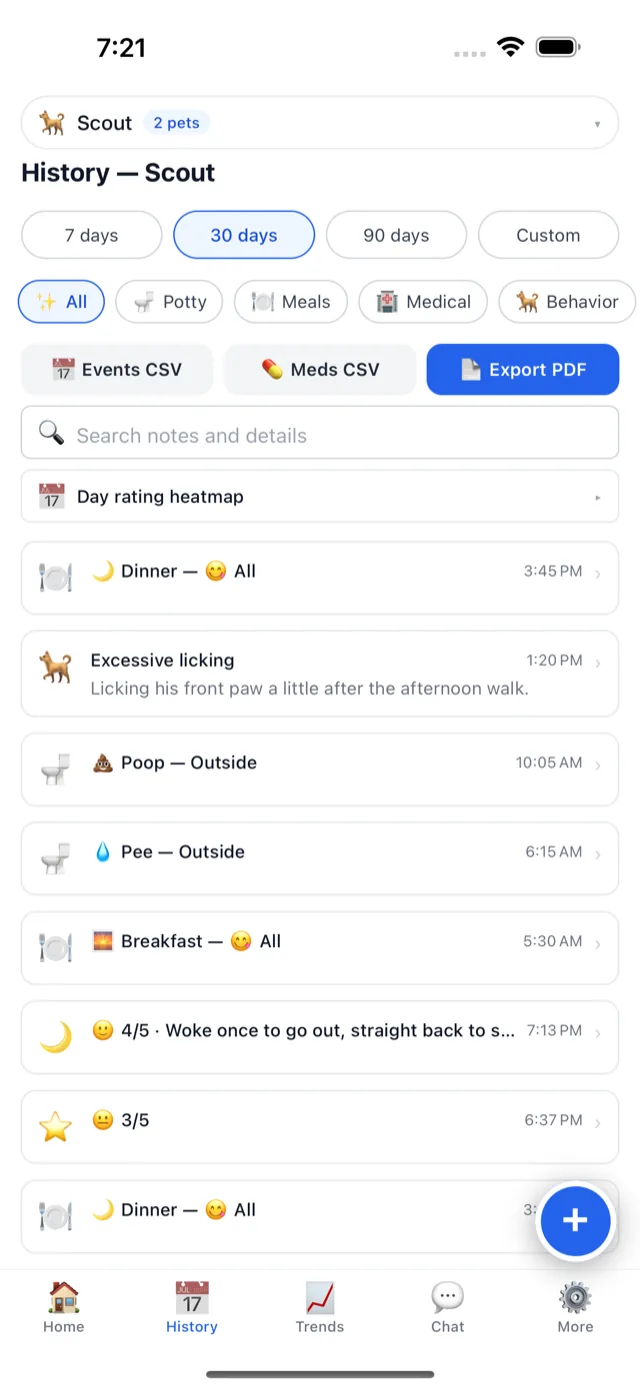
Letting someone outside the household see your pets’ records is always your choice, for one purpose, and it ends:
- A vet share link Premium is a read-only page of one pet’s recent history that your vet opens without an account. Anyone holding the link can open it, so send it only to your vet, and revoke it when the visit is done. It stops working 30 days after you create it, or the moment you revoke it.
- A temporary pass from the household owner lets a sitter or trainer see your pets, their current medication schedule, and today’s entries (depending on time zones, that can include yesterday’s), and log. It does not open the earlier history, and it ends by itself on the date the owner set.
Your records also stay yours:
- Export is free, on every plan. More → Export Data gives you a ZIP of your whole history, in JSON and CSV.
- Deletion is real. More → Delete Account removes your account, your reminders, and your chat history, and if you are the only member of your household, its pets and everything logged about them, photos included. If you share the household, the pets and their history stay for the people still caring for them, including the entries you added. It also asks PostHog and Google Analytics, two of the app analytics services described below, to erase what they recorded under your account; HeyCatch, which app versions up to and including 1.3.10 carry, we erase when you ask. Exactly what goes and what stays.
What happens to your data in the AI features?
The AI features send what you have logged to a model made by Anthropic, and your pet’s information is not used to train any model. Most of the AI features are part of Premium: the assistant, the paragraph in the Weekly Review and the Monday digest, and the pre-visit summary for your vet. To write those, what you have logged — entries, medications, notes, and your pet’s profile — is sent to a model, and we chose it carefully.
Since WagWatch 2.0 the same model also reads the label scan: a photo of a medication label or a vaccine record, turned into a draft you check before anything is saved.
- It is made by Anthropic, and what we send goes to Anthropic’s service to be answered; when that service cannot answer, the same model answers through Amazon Bedrock, in our own AWS account. Your pet’s information is not used to train any model, Anthropic deletes it within 30 days, and we do not share it with anyone else.
- Only your own household’s data is sent, never another household’s. Photos go only when you ask: to the assistant, about something you photographed (up to three photos attached to entries in the dates it is reading), and the photo of a label you scan, which we do not keep unless you attach it to the record (Premium).
- Apart from a label scan, which a household without Premium can do once a month, nothing is sent unless your household has Premium (a free trial counts). With Premium, two features send it without you typing anything: the Weekly Review, when you open the app on a day it has not summarized yet (on a week, if your Premium comes from a promo code or the referral reward), and the Monday digest, until every member of the household has turned the digest off. A conversation with the assistant is deleted about 30 days after its last message.
Does WagWatch use analytics?
Yes: we measure how WagWatch is used, to learn which screens get used and where people get stuck. A privacy post that skipped this would be marketing, so here is what the privacy policy says, in short.
In the iPhone and Android apps, PostHog records which screens you open, and when you are signed in it links what it records to your account, including your email address and display name.
App versions up to and including 1.3.10 also carry HeyCatch, which records the same and also which parts of the app you tap, including the text on or around what you tapped — so a pet’s name, a medication name, or the text of an entry can be part of its record. HeyCatch is built on PostHog and shares its storage on your phone, so on those versions those taps, text included, reach our PostHog too. We are taking HeyCatch out of the apps; a phone keeps sending to it until it runs a version without it. Neither PostHog nor HeyCatch records your screen or reads your photos.
The apps also tell Google Analytics for Firebase which screens are opened, with an internal account id and whether you are on Free or Premium — never your email, your name, or anything you logged — with the advertising identifier switched off. There is no analytics switch inside the apps today: email support@wagwatch.app and we will erase your analytics record. Deleting your account asks PostHog and Google Analytics to erase theirs; it does not reach HeyCatch yet, so if you are leaving, ask us for that one.
On this website, Cloudflare Web Analytics counts page views without cookies. PostHog and Google Analytics run here too, each keeping a randomly generated visitor id on your device that is not linked to a WagWatch account. If your device says you are in the EU, the EEA, the UK, or Switzerland, they wait until you say yes; everywhere else they run unless you switch them off on the privacy page.
The web app at app.wagwatch.app carries no analytics at all, because its links can contain share tokens. Crash reports from the apps carry an internal account id rather than your name or email (we can link it back to your account), and notes, medication names, and chat are scrubbed out before they are sent.
How will you know if this changes?
When a change matters, the privacy policy commits us to telling you in the app or by email before the change takes effect. This post describes WagWatch today, and the policy has the full detail. If anything here does not match what you see in the app, write to support@wagwatch.app — that is a bug. And if you want to know why WagWatch exists at all, our story is where it started.
Private by design, and still not your vet
WagWatch keeps your household’s log to yourselves, but it is a logging tool, not a veterinary service. The record you keep is yours to bring to your vet, and the decisions about your pet’s care are your vet’s.

Check it for yourself
Add a pet, log a day, then open More → Export Data and read what you logged, as we store it: every entry, medication, and vaccine, in JSON and CSV. The help pages cover export, privacy, and deletion, and shared households explains who sees what when more than one person logs.


Logging stays free for every entry, under the same privacy promises as Premium. Premium unlocks the full history, every pet, and the AI assistant — $3.99 a month or $24.99 a year, with a 14-day free trial for new subscribers in the iPhone and Android apps. In the iPhone and Android apps it can also be bought once, as Lifetime Premium for $69.99: one payment that never renews, for your whole household.