 WagWatch
Diet for a dog with kidney disease: track the transition
Key takeaways
- If your vet’s plan leaves time before the switch, log a week of your dog’s current meals, water intake and energy as a baseline.
- Record grams of food offered and eaten, water added versus drunk freely, and every snack or chew outside the plan, every single day.
- Follow the transition plan your vet or veterinary nutritionist gives you, change nothing else on your own, and log the step you are on at every meal.
- Compare the weeks after the switch with your baseline, because a run of skipped meals or shifting water intake shows your vet more than any single day.
- Bring the detailed log to your vet so they can judge the diet from real numbers rather than your memory.
Changing the diet for a dog with kidney disease is your vet’s decision, and when the new food is homemade, the recipe comes from a veterinary nutritionist. What happens at home after that is yours to record: grams eaten, milliliters of water, urine notes and energy, every day through the transition. That log shows the trend, settles disagreements between caregivers, and gives your vet real numbers instead of a vague “she’s been off her food lately.”
If your dog strains to urinate or cannot pass urine, vomits again and again or retches with nothing coming up, collapses or seems very dull, or has pale gums, call your vet or go to an emergency clinic now. All are on the emergency lists of the University of Wisconsin’s and Texas A&M’s veterinary teaching hospitals.
And call about anything your vet asked you to watch for. The log is for the days between visits, not a reason to wait for the next one.
Why does a homemade diet for a dog with kidney disease require meticulous daily tracking?
Renal diets are built around a few limits. The Merck Veterinary Manual describes them as low in phosphorus, with modest amounts of high-quality protein, and its edition for dog owners says your vet may suggest food designed for animals with kidney disease. A bag of renal food is made to that design; a homemade version is made in your kitchen, from a recipe that should come from a board-certified veterinary nutritionist when a pet has health problems, Tufts’ nutritionists say. The recipe is the professionals’ job; the log is yours.
Homemade batches can drift from the recipe
Tufts’ nutritionists say swapping ingredients or changing the cooking method can have big effects on a diet’s nutrients, and only 13% of their own clients were still following the original recipe 6 to 12 months later. So write down what went into each batch and how it was cooked; if something changes, the log shows when.
Kidney disease is checked at visits; the days between are yours
Merck’s owner manual has dogs with kidney disease seeing the vet every 3 to 6 months, or more often if there are problems, for blood and urine tests. The skipped meals, restless nights and changes in water intake in between are only visible in a daily record.
Shared households need one record, not four
When a partner, sitter, or walker feeds on different days, fragmented notes hide the pattern. One shared log, like WagWatch’s shared pet care log, keeps every caregiver writing to the same page, so “how has she been” has an answer.
What should you log before the first meal of the new diet?
One week on the current diet
If your vet’s plan leaves time before the switch, spend a week logging your dog exactly as she eats now; the baseline should never hold up the start your vet set. Record every meal, how much of it she finished, water bowl refills, skipped meals, and anything odd: a restless night, reluctance on stairs, an off appetite at one feeding. If a partner, sitter, or walker shares care duties, they log their shifts too, so the week has no gaps. This is your baseline, and without it, “before and after” is just a feeling.
What a useful baseline entry looks like
Keep it to four things: what she ate and how much, water intake, energy and appetite notes in one line, and any medication given. A shared log like WagWatch is built for this: everyone adds entries to the same record, so the pattern stays visible. Paper or a shared spreadsheet works too, as long as every caregiver uses it.
What specific dietary metrics should you log when feeding a dog with kidney disease?
Four numbers a day, written down by whoever feeds her, tell you more than a week of memory ever will.
Grams of food offered vs eaten
Weigh the bowl before and after. Record grams offered and grams eaten, not “she ate most of it.” A skipped meal is data; “mostly finished” hides the slow change you are trying to catch. If two people split feedings, each logs their own shift so the day adds up to one honest total.
Water added to food vs drunk freely
Merck’s owner manual says the earliest signs of kidney disease in dogs are usually excessive thirst and urination, so separate the two sources. Log the water you mix into the food, then how much the bowl loses on its own. If drinking and eating change together, tell your vet.
Snacks, chews, and anything off-plan
Renal diets limit phosphorus, and Merck’s owner manual lists a low-salt diet among the changes a vet may make, so anything outside the plan matters. Name it and estimate grams. “One dental chew” is enough; the point is that your vet sees the whole day, not just the meals.
| Metric | How to record | Why it matters |
|---|---|---|
| Food offered/eaten | Grams, weighed | Shows a drift in appetite early |
| Water (added vs free) | Milliliters, split by source | Puts drinking next to eating |
| Off-plan items | Item + rough grams | Shows your vet everything outside the plan |
Transition numbers only mean something against a known starting point, which is why the baseline matters before the first bowl of the new food; the one-page checklist of what to write down before a vet appointment covers the rest. How fast to switch is your vet’s or nutritionist’s call: follow the pace they set, so each shift in the log lines up with a step of the diet.
How do you track water consumption relative to food intake for a dog with kidney disease?
Weighing the water bowl
A kitchen scale is the only equipment you need. Fill the bowl to a set weight each morning, note it, and weigh it again at night. The difference in grams is roughly the milliliters your dog drank. Refills during the day just need a quick note from whoever tops it up, which is where a shared log like WagWatch earns its keep: one person’s note is in everyone’s history. Never cut back the bowl to make measuring easier; Merck lists “ensure adequate water intake” as part of care.
Wet-food moisture as part of the count
Homemade and wet food carry water of their own. Ask the nutritionist how much water the recipe carries, or check the label, and log the serving weight next to the bowl readings, or total intake looks lower than it is.
When the water numbers change
Note a change the day you see it, not the week after. Ask your vet at the start which changes they want to hear about, and how quickly, and write the answer at the top of the log. Straining to urinate, or not passing urine, is not a log entry; it is the call in the box above.
What symptoms should you monitor alongside a dog kidney disease diet?
Start with the signs Merck’s owner manual describes: usually excessive thirst and urination first, then, as the disease progresses, loss of appetite, weight loss, dehydration, mouth sores, vomiting and diarrhea. Whether the diet is working is your vet’s call, with blood and urine tests; your log is what they read it against.
Appetite, vomiting, and skipped meals
Note how each meal goes: finished without hesitation, picked at, eaten only if hand-fed, or skipped. Log every skipped meal and every vomiting episode, with the time, and anything you see around meals in your own words, such as lip-licking or eating grass. Log the good days too, because the pattern across a week is the signal.
Energy and restless nights
Note wake-ups, pacing, or accidents overnight, and who observed them. In a multi-caregiver household, the walker may see the afternoon slump the feeding partner never witnesses, which is exactly why every caregiver logs in the same place.
Weight and body condition
Weigh weekly, or as often as your vet asks, on the same scale at the same time of day, and ask your vet to show you how to feel for muscle along her spine and hips. Merck lists weight loss among the signs as the disease progresses, and no appetite log shows it. Keep every weigh-in dated and visible to the household. In WagWatch each weigh-in is a Weight entry with its date, in pounds or kilograms, and Trends draws them as a line.
How do you switch to the new diet without muddying the data?
The schedule your vet gives you
Your vet or nutritionist sets the pace of the switch and its steps. Write their plan at the top of the log, where everyone who feeds her sees it, and log the step at every meal: which day of the plan, how much old and new food. If Freya skips a meal partway through, the log shows exactly which step it was, and your vet decides what happens next.
One change at a time
Each new protein, supplement or feeding time makes the pattern harder to read, and Tufts’ nutritionists are blunt: never change a recipe without talking to the nutritionist who formulated it. When a change is made, make it with them, and note the date in the log. Small changes only read clearly when the background stays still.
Who logs what in a multi-caregiver household
Assign one person per meal, not per day, so entries don’t double up. The walker logs water and appetite; the partner logs medication and any restless night; you review the pattern weekly. A shared log beats a spreadsheet emailed between four people, which is where entries go missing.
How do you read the log once the switch has started?
Trends beat single bad days
A few weeks of entries gives you before-and-after pairs, not a verdict. Compare the weeks since the switch with your starting week: is she skipping meals more often, drinking more, resting worse? One skipped meal is one entry; several across a week or two are a pattern, and both belong in the log your vet sees. Weigh the bowl before and after each refill so the numbers are comparable.
When the numbers say call the vet
The signs in the box at the top are not diet-tuning problems; they are calls to make now. If she is not eating the new diet well, Tufts’ nutritionists say to talk to the nutritionist who formulated it, and tell your vet too. Bring the log itself, since proof a course was finished or a dose was missed reads better than memory.
How often should you share your dog’s diet and symptom log with your veterinarian?
Ask your vet at the start of the diet what they want to see and how often; some prefer weekly numbers during a diet change, others only flag events. Bring the log to every check-up, and send a short summary between visits whenever something changes: skipped meals, a jump in water drinking, weight loss, or a missed dose.
Between-visit summaries
A between-visit summary is three lines, not the full log: what she ate, how much water she drank, and any symptom worth mentioning. Send it when your vet asked for one, and whenever there is something to flag.
Bringing the history to the vet
Bring the log itself, printed or on your phone, with food amounts, water, symptoms, and any medications given. Vets read patterns, not anecdotes, and “she seemed off” carries less weight than “she skipped dinner twice and drank noticeably more after the switch.” If you see multiple clinics, the log travels with you, which is exactly the fragmented-history problem it exists to solve.
WagWatch works here too: everyone logs into the same record, and History’s Vet report PDF (the last 60 days free, any range on Premium) prints every entry with its time and notes, so you hand over the household’s log, not one person’s memory. Where it falls short: your vet still has to read it, since it sends nothing into the clinic’s own records.
Questions
What is the best diet for a dog with kidney disease?
The one your vet recommends for your dog. Renal diets, as the Merck Veterinary Manual describes them, are low in phosphorus with modest amounts of high-quality protein. If your dog will not eat it, ask your vet what else is possible; a home-cooked renal diet from a board-certified veterinary nutritionist is one option. Either way, log grams eaten, water and symptoms daily.
Can I feed my dog with kidney disease homemade food?
Only as a recipe your vet and a veterinary nutritionist have planned: Tufts’ nutritionists say it should be made exactly as written, supplements included, and never changed without talking to them. Weigh each batch’s ingredients, record grams offered and eaten every meal, and track water, snacks and symptoms daily, so your vet judges the diet from numbers rather than memory.
How much water should a dog with kidney disease drink?
That is your vet’s to say, for your dog, alongside the blood and urine tests. What the clinic does not have is your dog’s own number, day after day, measured the same way: weigh the bowl morning and night, log milliliters drunk separately from water mixed into food, and bring the trend. Never cut back the water to make measuring easier.
What foods should be avoided in a dog kidney disease diet?
Ask your vet, or the nutritionist who wrote the recipe, for your dog’s list. Merck’s owner manual says to keep phosphorus from being too high, and names low-salt food and, later on, limiting protein among the changes a vet may make. Every off-plan item counts: dental chews and table scraps are part of the day too, so name them and estimate grams in your log.
How long does it take to see improvement after changing a kidney disease dog diet?
Ask your vet: they judge the diet with blood and urine tests at rechecks. Your log covers the days in between. Compare the weeks after the switch with your starting week, and bring both, so the next recheck reads the diet against what actually happened at home.
Sources
Every general statement about kidney disease, renal diets, home-cooked recipes and emergencies on this page comes from one of these veterinary sources. WagWatch is not connected to any of them.
- Noninfectious Diseases of the Urinary System in Dogs, Merck Veterinary Manual, dog owners’ edition, by Scott A. Brown, VMD, PhD, DACVIM
- Renal Dysfunction in Dogs and Cats, Merck Veterinary Manual, by Laura Van Vertloo, DVM, MS, DACVIM
- What Nutritionists Wish You Knew: 5 Homecooked Diet Mistakes & Misconceptions, Petfoodology, Cummings School of Veterinary Medicine at Tufts University, by Cailin R. Heinze, VMD, MS, DACVIM (Nutrition), 2023
- Should you make your own pet food at home?, Petfoodology, Tufts, by Cailin R. Heinze, 2016
- When to Seek Emergency Care for your Pet, University of Wisconsin School of Veterinary Medicine, 2023
- Emergency Medicine, Veterinary Medical Teaching Hospital, Texas A&M College of Veterinary Medicine & Biomedical Sciences
Not a substitute for your vet
WagWatch is a tracking and logging tool, not a veterinary service. Its job is to help you bring a clear, accurate history to the people who care for your pet professionally.
Log it in WagWatch
WagWatch keeps this log as entries in your dog’s record, next to the doses and everything else, shared by everyone in your household. Logging is free on every plan.
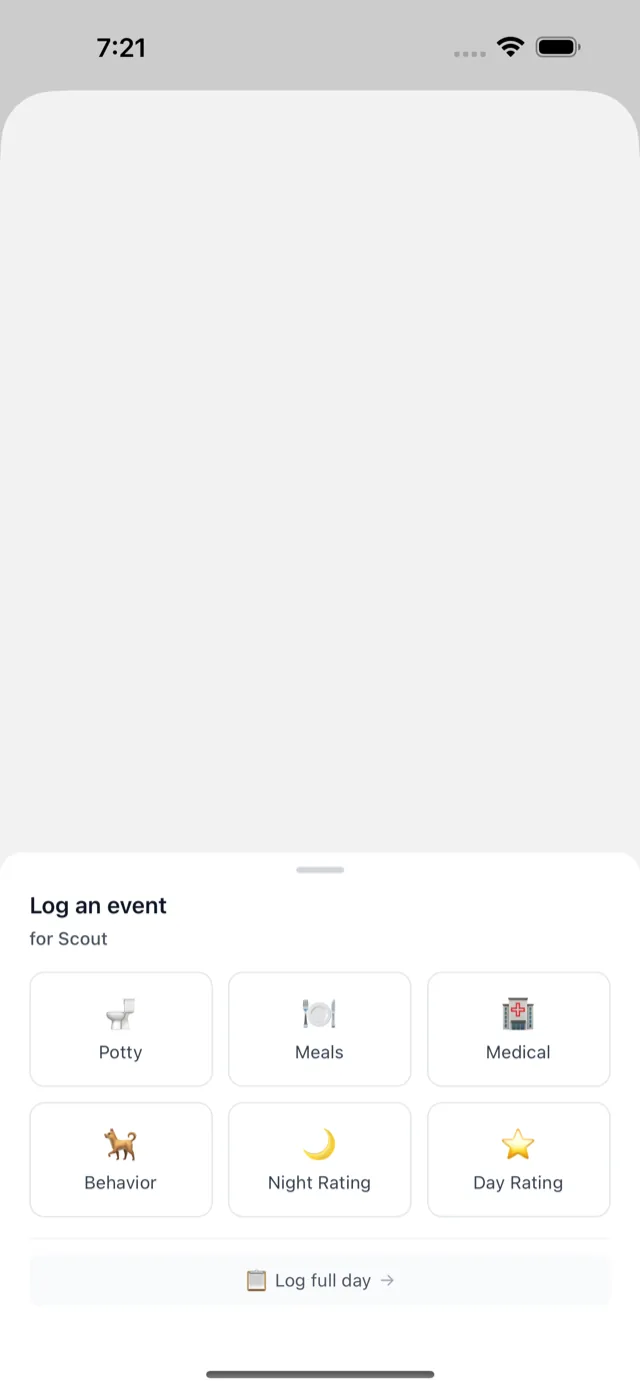
Screen shown is from the iPhone app, with our sample pet. The Android app and the web app offer the same kinds of entry, and since October 27, 2026 all three have an eighth, Weight, which this screen predates.
- Meals. Log each one with All, Some or None eaten. There is no grams field, so put the grams offered and eaten, and the step of the switch, in the meal’s note. A snack or chew is an Other meal, named in its note.
- Water and weight. WagWatch has no water counter, so write the day’s bowl readings in a note; History’s Search notes and details finds every one later. Log each weigh-in as a Weight entry, in pounds or kilograms: Trends draws them as a line, and the newest one becomes the weight on your dog’s profile.
- Symptoms and nights. Medical entries for Vomiting, Loss of appetite or Excessive thirst, with an optional severity; a 1–5 rating for the night, with a note; a Behavior entry for Pacing.
- At the visit. History’s Vet report PDF: your dog’s profile and medications, then every entry in order with its time and your notes. Free for the last 60 days; any range on Premium. Or a share link Premium, a read-only page your vet opens without an account. What your vet sees.
Everyone you invite logs into the same record from their own phone or a browser, and every entry shows who logged it. The help pages cover logging and sharing with your vet step by step, and the dog page has more on what to log for a dog. More posts are on the blog.


Free to use every day, the whole log included. Premium adds the full history, photos on entries, vet share links, every pet and the AI assistant — $3.99 a month or $24.99 a year, with a 14-day free trial for new subscribers in the iPhone and Android apps.