Puppy potty training log: a free printable, and what to do with three weeks of it
A puppy potty training log records every trip outside and every accident: the time, pee or poop, whether it happened where it should have, and what came just before. After three weeks, the daily totals show whether accidents are falling, how long your puppy can go between trips, and which events usually come first.
House-training is a counting problem dressed up as a patience problem. Every new puppy owner is guessing at one question, "Is this week better than last?" It has a real answer, but only if the breaks get written down. Below is a log you can print now, and what to look for once it has three weeks on it.
What goes in a puppy potty training log?
A puppy potty training log gives every trip outside and every accident a row, one sheet per day: the time, whether it was pee or poop, and whether it happened where it should have. The notes column is for what came just before: woke up, finished a meal, big play session, left alone.
Potty log
Puppy: Date: Age:
| Time | Pee | Poop | Outside | Accident | Just before / notes |
|---|---|---|---|---|---|
| ☐ | ☐ | ☐ | ☐ | ||
| ☐ | ☐ | ☐ | ☐ | ||
| ☐ | ☐ | ☐ | ☐ | ||
| ☐ | ☐ | ☐ | ☐ | ||
| ☐ | ☐ | ☐ | ☐ | ||
| ☐ | ☐ | ☐ | ☐ | ||
| ☐ | ☐ | ☐ | ☐ | ||
| ☐ | ☐ | ☐ | ☐ | ||
| ☐ | ☐ | ☐ | ☐ | ||
| ☐ | ☐ | ☐ | ☐ | ||
| ☐ | ☐ | ☐ | ☐ | ||
| ☐ | ☐ | ☐ | ☐ |
Accidents today: Successful trips:
How do you fill in a potty training log?
Fill in the log every time the puppy goes out, good trips included, with the time and what came just before:
- Log every trip, not just the accidents. A day with two accidents and fourteen good trips is a good day. Without the good trips written down, the sheet only ever says "two accidents."
- Write the time, even roughly. The pattern you are looking for lives in the times: how long after a meal, how long after waking, how long since the last trip.
- Note what came before. "After breakfast," "after the nap," "was playing." Most puppies have two or three reliable triggers; the notes column finds them within a week.
- Everyone who takes the puppy out uses the same sheet. The most common gap in a log is the trip someone else took and did not write down.
- Total the day at the bottom. Two numbers a day, accidents and good trips, are what you will compare across weeks.
What does three weeks of potty logging tell you?
Twenty-one days of totals tell you three things: whether it is working, the interval, and the triggers. One accident on its own tells you nothing.
Whether it is working
Accidents per week should fall, unevenly. A week with more accidents than the last is not failure, it is a week to look at: a change in food, a new schedule, a visitor, a growth spurt. If the number does not fall over three weeks, that is worth a conversation with your vet, because it may not be a training question at all.
The interval
From the times, you can read how long your puppy can currently go between trips. It is usually shorter than the rule of thumb and it lengthens as the weeks pass. Taking the puppy out a little inside that interval, rather than waiting for a signal, is most of what house-training is.
The triggers
The notes column will show that most successful trips, and most accidents, follow the same two or three events. Once you know them for this particular puppy, you can be at the door before they are.
Doing the same thing in WagWatch
The sheet above is the potty feature in WagWatch, with the counting done for you. It is free on every plan.
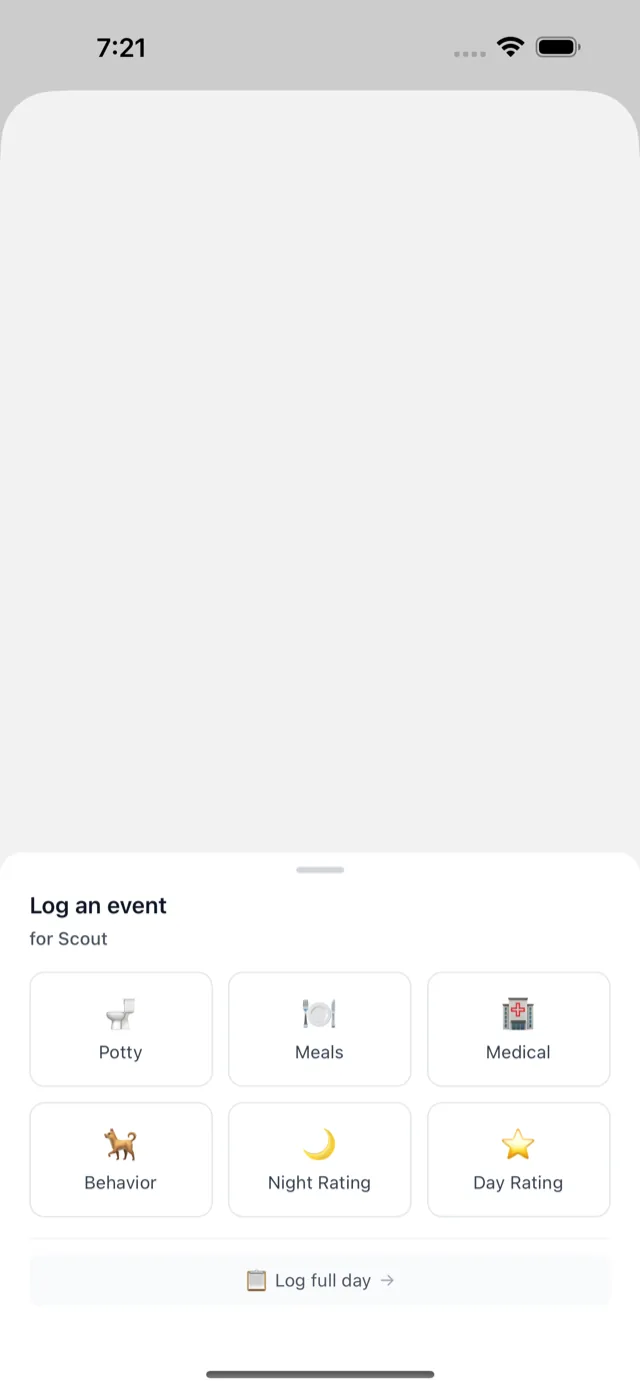
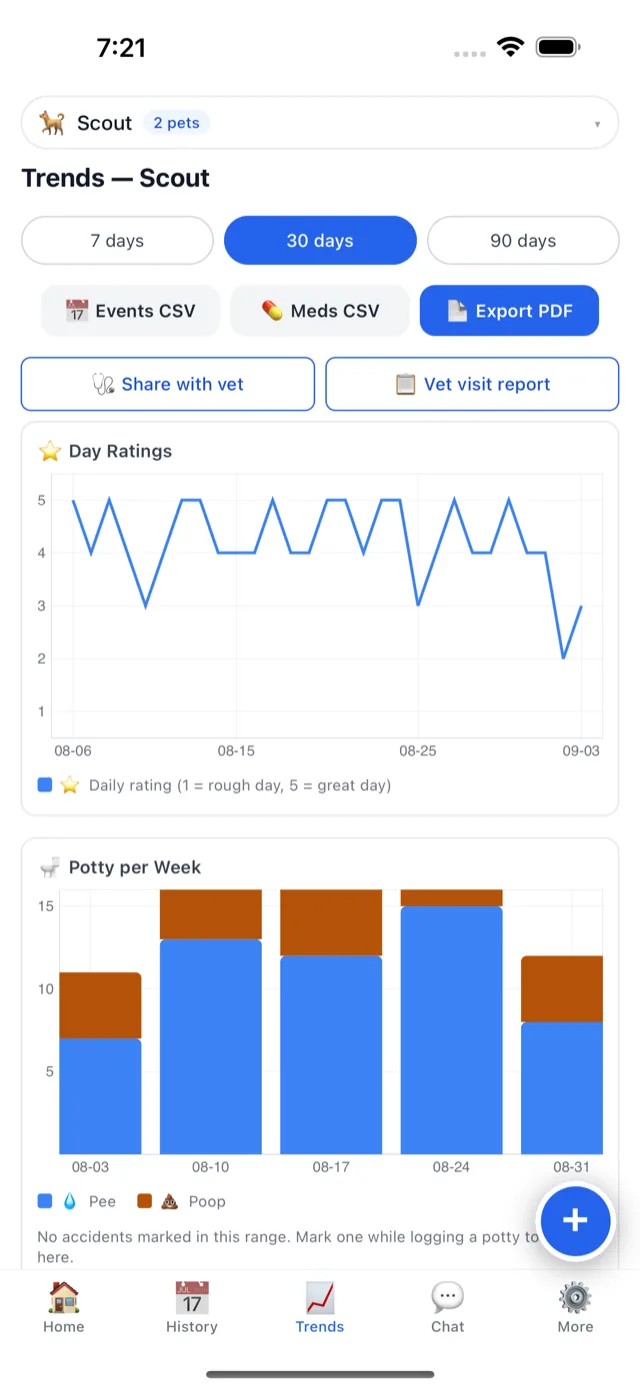
- One entry per trip, in a few taps: pee or poop, where it happened, and an accident flag. Every entry carries a time you can adjust afterward, so a trip you log from the sofa five minutes later still has the right time.
- The weekly potty chart on the Trends screen plots trips per week with a dashed trend line, which is the "is this week better than last?" question answered in one glance.
- History you can filter to potty entries only, so the times and the accident flags are one scrollable list rather than a stack of sheets.
- Everyone logs into one record. Invite whoever shares the walks to your household and their trips land in the same history from their own phone. How shared households work.
- It works offline in the yard or at the park on iPhone and Android, and syncs when you are back in range. With an Apple Watch you can log the trip from your wrist and leave the phone indoors. How the watch app works.
Meals go in the same log with how much was eaten, which matters here because a puppy's potty schedule follows its meal schedule. Three weeks of both, side by side, is the whole picture. More on what to log about a dog.
When can you stop counting potty trips?
You can stop counting when a week goes by with no accidents and you have stopped thinking about it. Keep the log anyway: the same entries become the record of what is normal for this dog, and normal is what you will want to compare against for the rest of their life. Here is why that matters later.
The tally is yours; the health questions are your vet’s
WagWatch counts the trips and the accidents; it is a logging tool, not a veterinary service. If the accidents do not fall, whether something more than training is going on is your vet’s call.

Log the next trip outside
Print the sheet, or add your puppy in WagWatch and log the next trip outside. Either way, log the good ones too.


Logging every trip outside, accidents included, is free on the free plan, as is every other entry, every day. Premium unlocks the full history, every pet, and the AI assistant — $3.99 a month or $24.99 a year, with a 14-day free trial for new subscribers in the iPhone and Android apps. In the iPhone and Android apps it can also be bought once, as Lifetime Premium for $69.99: one payment that never renews, for your whole household.