 WagWatch
Seven small changes worth logging in a senior pet
None of these is alarming on the day it happens. That is the problem. An older pet changes slowly, and the changes are exactly the kind you explain away one at a time: a slow morning, a skipped dinner, an accident overnight. Written down for a month, they either add up to a pattern or they do not, and either answer is worth having before the next appointment.
This is the list we wish we had kept for Daisy, the senior dog WagWatch was built around. Her story is here. Every item below is something the app logs in one or two taps, but the list works on paper too. The point is that it gets written down.
1. Eating a little less
Appetite rarely collapses in a senior pet. It drifts. A bowl left a quarter full, a dinner picked at, a cat who walks away from the second half. Bowl by bowl there is nothing to see. Over three weeks, the amount eaten is a line, and a line that slopes is a question for your vet.
What to log: every meal, with how much was eaten. In WagWatch a meal entry carries the amount, and the Trends screen charts it.
2. Drinking more, or drinking less
A water bowl that empties faster than it used to, or a pet that stops visiting it, is one of the first things a vet asks about in an older animal. It is also one of the easiest to miss, because nobody watches a water bowl.
What to log: WagWatch has no dedicated water counter yet, so note the bowl level in the note field of a meal entry, and log a medical event on the day you first notice a real change, so it has a date.
3. Accidents, or asking to go out more
A house-trained dog who has an accident overnight, a cat who goes next to the box instead of in it, a pet who suddenly needs to go out at 3 a.m. Once is a bad night. The week it starts is information.
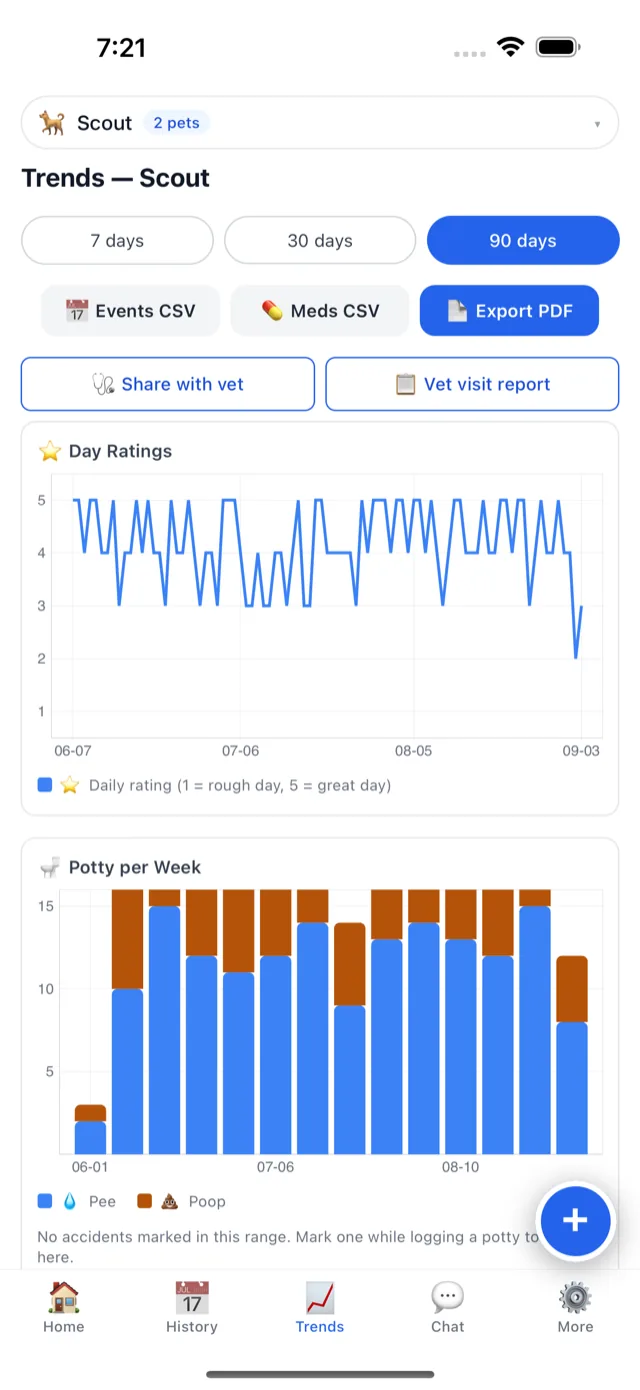
What to log: every potty break, with where it happened and the accident flag. The weekly potty chart shows the count going up, and the accident flag makes the week it started easy to find.
4. Restless nights
Pacing, panting, getting up and settling and getting up again, a cat who yowls at 2 a.m. Night-time restlessness in older pets is common enough that people stop noticing it, and hard to describe at an appointment three weeks later ("she's been a bit unsettled").
What to log: the night rating. WagWatch asks for a 1 to 5 rating for the day and one for the night; the night line, plotted over a month, says more than "a bit unsettled" ever could. Add a behavior entry on the worst nights so the detail is there too.
5. Slower to get up, on the stairs, on the walk
The walk that used to take twenty minutes takes thirty. The jump onto the bed becomes a climb. The first few steps after a nap look stiff. Each of these is a shrug on its own; together, and dated, they describe a trajectory.
What to log: a behavior entry when you notice it, with a word or two of detail. "Hesitated at the stairs" on six dates in a month is a sentence your vet can work with.
6. A new lump, a spot, a smell
Older pets grow things. Most are nothing. The question a vet will ask is "how long has that been there, and has it changed?" and the honest answer from memory is usually "a while, I think".
What to log: a medical event on the day you find it, with a severity note. On Premium, attach a photo to the entry so the next photo, a month later, has something to be compared with.
7. Withdrawing
The dog who stops meeting you at the door. The cat who spends the afternoon under the bed instead of on the windowsill. This is the change families notice last, because it is an absence rather than an event, and the one they most often describe as "just getting old".
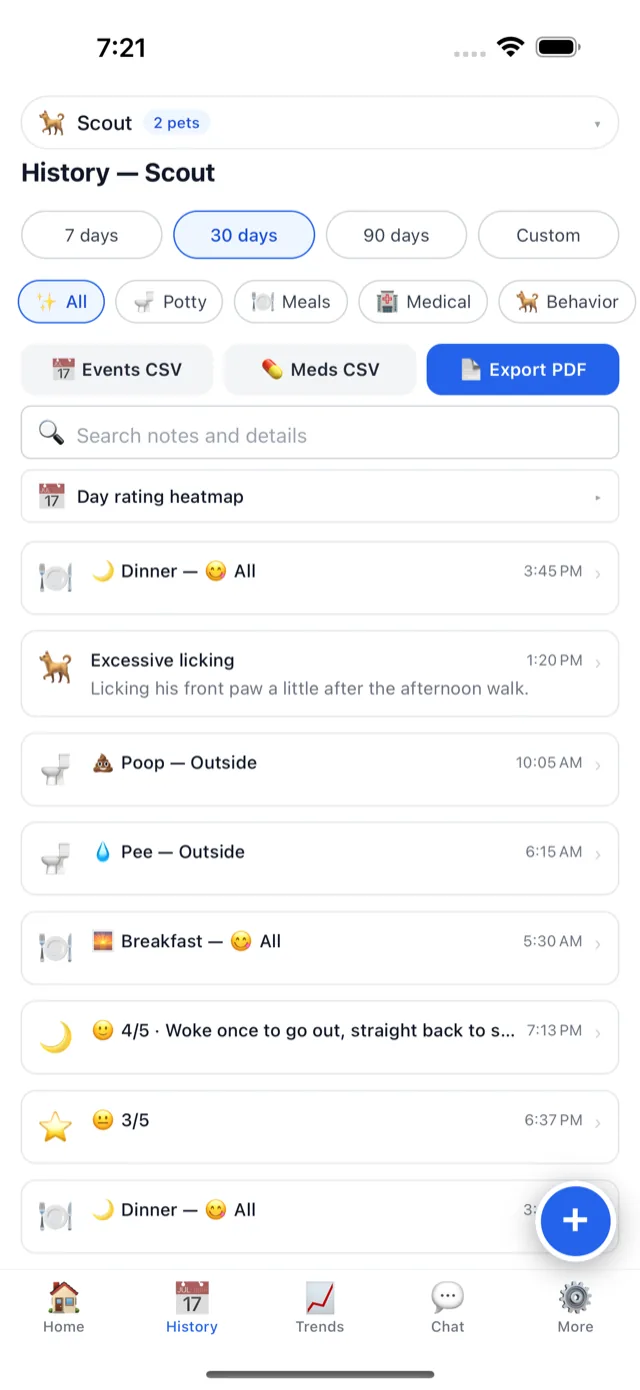
What to log: a behavior entry when it strikes you, and the day rating every day. The day rating is the overall line that makes the other charts readable; a month of 3s where there used to be 4s is visible in the calendar heatmap at a glance.
What a month of this looks like
Logged in WagWatch, the seven items above become one history. The Trends screen plots day and night ratings day by day, with potty and medical events as weekly lines and a dashed trend line on each. The calendar heatmap shows good days and hard days, so a bad fortnight stands out from a bad Tuesday. History is searchable, so "when did the stairs thing start?" has a date instead of a guess.
On Premium, the Weekly Review writes a short, dated summary of what changed in the last seven days from your own log, and the AI assistant can answer "how has she been this month?" from the same record.
Bringing it to the appointment
- A PDF summary of the last 90 days, free, in one tap. Any date range on Premium.
- A CSV or JSON export of every event and medication, free on every plan.
- An expiring, read-only share link your vet can open without an account Premium.
- A one-tap vet visit report over the last 90 days, with questions to ask Premium.
If the pet already takes a daily medication, the same history holds every dose you confirmed, next to the day's rating, so the weeks before and after a change sit side by side. How medications and reminders work.
If more than one person notices things
The person who does the morning walk sees the stiffness. The person who feeds dinner sees the bowl. A household in WagWatch is one shared record: invite whoever shares the care and everyone logs from their own phone, or from a browser, into the same history. How shared households work.
Not a substitute for your vet
WagWatch is a tracking and logging tool, not a veterinary service. Its job is to help you bring a clear, accurate history to the people who care for your pet professionally.
Start with one thing
Add your pet, log tonight's meal and how the day went, and see how it lands in the day view. It takes about a minute. The species pages have more on what to log for a dog and a cat, and the help pages cover logging in detail.


Free to use every day. Premium unlocks the full history, every pet and the AI assistant — $3.99 a month or $24.99 a year, 14-day free trial.