 WagWatch
Dog and arthritis symptoms: a stage-by-stage timeline
Key takeaways
- Early dog arthritis symptoms are often subtle: a slower rise after rest, hesitation on stairs, less jumping, shorter walks.
- Arthritis is chronic and progressive, so signs tend to build from mild to severe, which is why notes beat memory.
- Arthritis signs are easy to mistake for slowing down with age; write down what you see and let your vet sort the two.
- Recent activity and even the weather can change how stiff she is, so a two-week pattern across conditions says more than one bad day.
- A shared daily log turns scattered observations from multiple caregivers into dated evidence your vet can act on.
Dog and arthritis symptoms tend to build from subtle to obvious: a slow rise after a nap, hesitation on the stairs and shorter walks can come long before a visible limp or a dog who will not move at all. This guide maps each stage and gives you a two-week checklist, so you can show your vet dated observations instead of a vague “she seems stiff.”
What are the earliest symptoms of dog arthritis most owners miss?
The first signs rarely look like limping. They look like small changes you already notice and file under “getting older”: hesitating at the bottom of the stairs, taking longer to stand up after a nap, cutting the evening walk short, or a flash of grouchiness when you touch a sore spot. Cornell’s Riney Canine Health Center lists stiffness, reluctance to walk, trouble with stairs or jumping, difficulty getting up and irritability among the signs, and the Merck Veterinary Manual says subtle signs exist long before obvious ones. Individually, each one is easy to dismiss. Together, and repeated over weeks, they are the pattern.
The 10-second morning test: watching your dog rise
Watch your dog get up from sleep once a day. Count nothing, time nothing, just watch, and write down what you saw: a pause, a second try, stiff first steps. Merck lists slowness to rise, especially after a long rest, so do this after long naps too. If you can, film it: Cornell calls home videos “extremely helpful”. Unsure what to say to your vet? See what to write down before a vet appointment.
Why early signs get dismissed as ‘just getting older’
Slowing down is easy to put down to age, and Bristol Veterinary School says it is not uncommon for arthritis signs to be misread exactly that way. Gradual changes that keep drifting in one direction, fewer stairs, shorter walks, a skipped meal after a hard day, are worth recording rather than explaining away. The problem is memory: nobody in a multi-caregiver household can say whether this week was worse than last month. A log turns vague impressions into vet-visit evidence.
What symptoms of dog arthritis appear at each stage of progression?
Cornell calls osteoarthritis “a chronic and progressive joint disease that commonly affects dogs”, with signs from mild to severe depending on how long it has gone on and how many joints are involved. The three stages below organize your notes; they are not a grade. Vets stage arthritis themselves, with tools such as COAST, which Merck describes as a 0 to 4 scale built on risk factors, the owner’s observations, the exam and X-rays. The stages blur, which is why week-to-week notes matter more than memory.
Early stage: stiffness that comes and goes
The first signs are easy to dismiss. She hesitates before jumping into the car, takes the stairs slower after a long walk, or stands up stiff on a cold morning and moves more freely an hour later. Nothing is consistent yet, so most owners file it under “getting older” and say nothing at the next vet visit.
Moderate stage: the pattern becomes visible
By now the stiff moments happen often enough that different people in the household each notice a piece of it. One person sees the restless night, another the shortened walk, and nobody can say whether this week was worse than last. This is where a shared log earns its keep: a few entries a day from whoever is home turn scattered impressions into before-and-after evidence you can bring to the vet.
Late stage: mobility changes you cannot miss
Reluctance to get up or walk, a visible limp, muscle wasting over the hindquarters, slipping on floors. At this point the pattern is obvious, and Cornell is clear about timing: the earlier arthritis is found and managed, before it progresses far, the better the long-term outcome. The goal is to arrive at the vet earlier than this stage.
| Stage | What you may see | What to record |
|---|---|---|
| Early | Hesitation before jumps, stiffness after walks or rest | Which activity, and how long the stiffness lasted |
| Moderate | Slower stairs, shorter walks, less play | How often each week, bad days against good days, restless nights |
| Late | Reluctance to get up or walk, limping, muscle loss | Every episode, plus the time of every dose your vet set |
Log entries in WagWatch belong to the household, not one phone, so a sitter’s note about a skipped meal sits next to yours. Read the full rules on what we do with that data in our terms of service.
How do dog knee arthritis symptoms differ from hip or spine arthritis?
Where the trouble sits changes what you see, and arthritis is not the only thing that can sit there. Cornell’s guide to a limping dog names a torn cranial cruciate ligament and hip arthritis among the common causes of a back-leg limp in older dogs, and elbow and shoulder problems for a front leg.
Knee (stifle): the back leg that stops taking weight
Cornell calls the cranial cruciate ligament the dog’s version of the ACL, and Merck lists cruciate rupture among the conditions that lead to arthritis in dogs. When it tears, Cornell says, a dog may suddenly stop bearing weight on the leg, and the knee may feel swollen or unstable. A sudden stop like that is a call-now sign (see below); a limp that comes and goes is one to write down, with which leg and when.
Hips: rising is the hard part
Cornell’s page on hip dysplasia, a loose hip joint that over time leads to arthritis, lists difficulty getting up, “bunny-hopping” when running, stiffness in the back legs, unwillingness to jump, less muscle on the hindlimbs, a sway in the hips, and weight shifted onto the front legs.
Spine and neck: when jumping stops
Back and neck pain may come from a spinal disc instead. Cornell’s pages on disc disease list reluctance to jump, walk, be petted or lifted, crying out when moving, a stiff neck or arched back, and a dog who walks to her bowl and just looks at it. Their advice is to contact your vet at the first sign of back discomfort. One caution: you cannot tell from home where it hurts or why, and neither can a shared log. Recording what you see, then bringing that history to the vet, is the honest division of labor.
How can you tell arthritis pain from the slowing down that comes with age?
At home, you often cannot; that is your vet’s job. Your part is the details that help them, and Cornell notes arthritis can develop at any age, so “she’s just old” explains nothing on its own.
Three things are worth a line each. Timing: does the stiffness ease after a few minutes of moving, or does she stay sore? Which legs: one leg, both back legs, or a limp that shifts between legs, which Cornell’s limping guide asks about. Mood and appetite: Bristol lists soreness when touched and character changes such as withdrawal or aggression, so a grumble when you touch her hip belongs in the log.
Log a small change the first time you see it, and keep logging it. One stiff morning is a note; the same hesitation on the stairs every Tuesday after the long walk is a pattern. You do not need two weeks of it to call your vet. In a multi-caregiver household, agree on what is worth logging and review the week together; on Premium, the Weekly Review writes up your pet’s week from your log.
How do arthritis symptoms in dogs change with weather, exercise, and time of day?
Bristol’s vet school says arthritis pain can depend on recent activity, medication and even the weather. Merck notes slowness to rise especially after a long rest. So the dog who trotted up the porch steps on a sunny Tuesday may hesitate in a rainy week, and a long Saturday walk may show up as a stiff Sunday. Write down the weather, yesterday’s exercise, and how long she had been lying down.
This is why a single bad day proves little. The pattern across weather, activity and hours is the evidence, and no one person sees all of it: one walker meets the sunny-day dog, your partner the rainy-day dog. A shared log in WagWatch puts both days on the same timeline, so “she seems stiff” becomes a record of when, after what, and in what weather.
When do symptoms of dog with arthritis mean it’s time to see a vet?
If your dog suddenly collapses, seems very weak, cannot use a leg, cries out, trembles or cannot move, call your vet or go to an emergency clinic now. Cornell’s Riney Canine Health Center lists these among the reasons to see a vet right away: they can be linked to injury or other serious conditions. Log it afterwards.
A steady decline is the other reason. If your notes show she hesitates on stairs she used to take without thinking, or restless nights keep following long walks, book a visit even though nothing looks dramatic on any single day.
Do not wait for late-stage signs to start the conversation: your vet can do more with “she slowed down this month” than with “she cannot get up anymore”. Bring the history; two weeks of concrete observations beat “she seems stiff” every time.
What should you observe and record before a vet appointment about suspected arthritis?
“The vet asked how has she been, and I said she seems stiff. That’s not evidence.” Vets have validated owner questionnaires for exactly this, such as the Liverpool Osteoarthritis in Dogs (LOAD) and the Canine Brief Pain Inventory, which score what owners observe; Merck lists both, and LOAD’s validation study in 222 dogs is on PubMed Central. You can borrow the idea at home: record behaviors, not moods. Cornell’s limping guide asks for the same: when it started, suddenly or gradually, whether it is getting better, worse or shifting between legs, and any difficulty with stairs, jumping, rising or exercise.
The printable two-week checklist
For each day, note the date, how she got up, stairs taken or avoided, walk length and where she hesitated, restlessness at night, and the weather. Add one column owners forget: who observed it. The walker sees the hesitation points the partner never does, and the sitter catches the restless night nobody else witnessed. Two weeks of rows from three people is the pattern; one row is an anecdote.
Arthritis log, two weeks
Suddenly cannot use a leg, collapses, cries out or cannot get up: call your vet or an emergency clinic now.
| Date | Getting up after sleep or rest | Stairs: taken, slow or avoided | Walk: how long, where she hesitated | Night: settled or restless | Weather | Who saw it; notes |
|---|---|---|---|---|---|---|
Turning notes into vet-visit evidence
Bring the printed log to the appointment and open with it before the vet asks anything. “Over fourteen days, she avoided the stairs on eight mornings, all of them cold or damp; her walk shortened from 25 to 15 minutes; she got up four times a night on six of the last seven nights, and two different people recorded that independently.” That sentence does three things a vague “she seems stiff” cannot: it shows the before and after, it shows the observations survived a change in observer, and it gives the vet something to examine against. It also survives the fragmented-records problem, since the log travels with you even if the X-rays live at another clinic.
How does a shared daily log make the pattern visible?
A paper notebook works, but only if everyone uses the same one. Once a walker, a partner and a sitter each keep their own notes, the pattern falls apart.
WagWatch is built for that household problem. Anyone who cares for the dog logs the day in seconds: skipped meal, restless night, hesitation on the stairs. Before the appointment, the Vet report PDF from History lists those entries with their dates, times and your notes (free for the last 60 days). A share link (Premium) gives your vet a read-only page of the last 90 days, with counts of each kind of entry and every medical entry in full, so log a limp as a Medical entry if you want it listed there. Compared with a shared spreadsheet, it trades flexibility for speed of entry.
Where it falls short: WagWatch does not tell you what is wrong, score pain, or stand in for an exam and X-rays. It turns “she seems stiff” into dated, shared observations your vet can act on.
Questions
What are the first signs of arthritis in a dog?
The earliest signs rarely look like limping: slowness to rise after rest, trouble with stairs or jumping, reluctance to walk, irritability (Cornell, Merck), and soreness when touched (Bristol). Repeated over weeks, they form the pattern worth logging.
At what age do dogs usually get arthritis?
Earlier than many people think. Merck says up to 40% of dogs aged 8 months to 4 years have osteoarthritis, though signs are generally not picked up until 5 to 13 years, and Cornell says it can develop at any age. What matters more than the calendar is the pattern.
Can dog arthritis come on suddenly?
The joint changes build over time, but visible signs can seem to appear suddenly, and Cornell’s limping guide puts “suddenly or gradually?” among the questions your vet may ask. A dog who suddenly cannot use a leg, cries out or cannot get up needs a vet now, whatever the cause.
How do I know if my senior dog is in pain from arthritis?
You often cannot be sure at home; your vet can. Write down whether stiffness eases after a few minutes or persists, whether it is one leg or several, and any change in mood or appetite. Your vet may also ask you to fill in a pain questionnaire such as LOAD or the Canine Brief Pain Inventory.
What can I give my dog for arthritis pain at home?
Nothing for pain without your vet’s involvement. Merck’s pet-owner manual says human anti-inflammatory pain relievers, ibuprofen among them, should not be used in pets unless your veterinarian directs it; in dogs, longer use of ibuprofen can cause stomach ulcers and kidney damage. What you can do at home is observe and record: keep a dated log of stiffness, hesitation points and bad days, then bring that two-week history to your vet.
Sources
Every general statement about arthritis, joint and spine problems and pain on this page comes from one of these veterinary sources. WagWatch is not connected to any of them.
- Osteoarthritis, Riney Canine Health Center, Cornell University College of Veterinary Medicine
- What to expect when taking your limping dog to the veterinarian, Riney Canine Health Center
- Canine hip dysplasia (CHD), Riney Canine Health Center
- Chondrodystrophy and intervertebral disc disease (CDDY/IVDD) and Intervertebral disc disease, Riney Canine Health Center
- When to go to the ER, Riney Canine Health Center, June 2025
- About Arthritis, Bristol Veterinary School, University of Bristol
- Osteoarthritis in Dogs and Cats, Merck Veterinary Manual, by Mark E. Epstein, DVM
- Poisoning from Human Over-the-Counter Drugs, Merck Veterinary Manual, pet owners’ edition, by Safdar A. Khan, DVM
- Evaluation of Construct and Criterion Validity for the ‘Liverpool Osteoarthritis in Dogs’ (LOAD) Clinical Metrology Instrument, Walton MB, Cowderoy E, Lascelles D, Innes JF, PLoS One, 2013
Not a substitute for your vet
WagWatch is a tracking and logging tool, not a veterinary service. Its job is to help you bring a clear, accurate history to the people who care for your pet professionally.
Log it in WagWatch
The checklist fits WagWatch’s log sheet, and logging is free on every plan:
- Stiffness and hesitation. A Behavior entry with Other (custom) in your own words, such as “slow on the stairs after the long walk”. Every entry has a time you can adjust, and notes.
- A limp. A Medical entry: Limping is on a dog’s list, with an optional severity.
- Nights and days. The Night Rating and the Day Rating, 1 to 5 each, the night with a note.
- Finding it later. History searches your notes and details; Trends draws day ratings day by day, medical entries per week, and behavior entries as weekly bars.
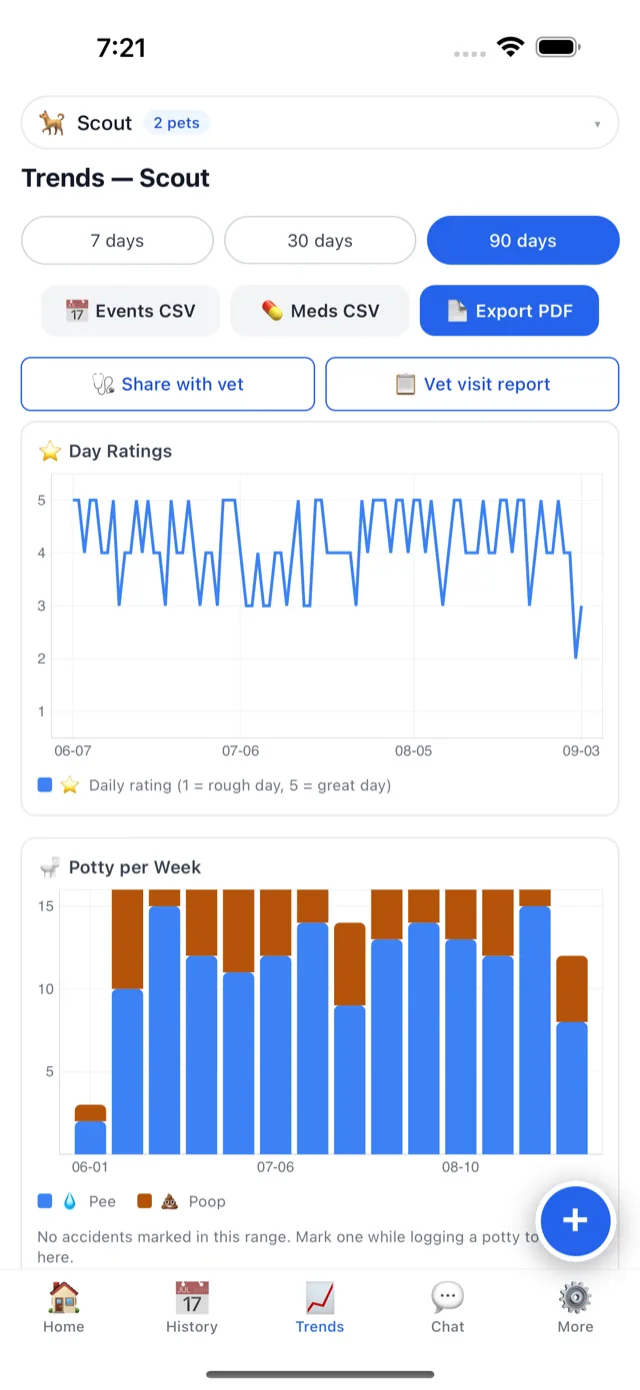
Screen shown is from the iPhone app, with our sample dog. The Android app and the web app have the same charts.
Everyone in your household logs into the same record from their own phone or a browser, and every entry shows who logged it; a sitter can have a temporary pass. The help pages cover logging and sharing with your vet, how to read Trends explains the charts, shared households shows how everyone’s entries land in one record, and the dog page has more on what to log for a dog. More posts are on the blog.


Free to use every day, the whole log included. Premium adds the full history, photos on entries, vet share links, every pet, the Weekly Review and the AI assistant — $3.99 a month or $24.99 a year, with a 14-day free trial for new subscribers in the iPhone and Android apps.