 WagWatch
A senior cat care routine you can actually keep
Key takeaways
- Track five daily markers (appetite, water, litter box, grooming, sleep) so your vet sees a pattern, not a memory.
- Cats over 10 are senior, and the guidelines recommend a checkup at least every six months: cats hide ailments well.
- A senior cat that stops eating needs a call to your vet now, not tomorrow.
- Low-entry litter boxes and ramps at favorite perches help arthritic cats get around your home.
- Use a shared daily log so everyone who cares for your cat sees the full picture instead of fragmented memories.
Senior cat care comes down to a short daily routine: track appetite, water, the litter box, grooming and sleep, and bring the pattern to your vet, with a call straight away for the few signs that cannot wait. This guide covers what to watch at the food bowl, in the mouth and around the house, plus a printable daily checklist and a table of what means “call your vet now” versus “write it down for your vet”.
What counts as a senior cat, and what changes at each age stage?
The 2021 AAHA/AAFP Feline Life Stage Guidelines call a cat a mature adult at 7 to 10 years and a senior over 10, and recommend a checkup at least every six months for seniors. The AAFP’s senior care guidelines add every four months for a cat over 15 with no known health problems.
The age stages vets use
| Stage | Age | What to do now |
|---|---|---|
| Mature adult | 7–10 | An exam at least yearly; ask your vet about baseline tests. Start a weight record. |
| Senior | Over 10 | Checkups at least every six months; the five daily markers. |
| Senior, over 15 | Over 15 | Every four months with no known health problems, more often with them; home setup for stiff joints. |
What changes first: teeth, kidneys, joints, senses
Kidney disease often runs for months or years before a cat shows any sign (Merck), and Cornell cites studies putting dental disease at 50 to 90% of cats over four. Joint stiffness shows as hesitation before a jump, and some older cats lose sight or hearing. The AAFP’s senior care guidelines name the reason exams matter: a cat’s “innate ability to hide ailments”. The small daily shifts worth logging are covered in seven small changes worth logging in a senior pet, so you can tell your vet what changed and when.
How should I adjust food and water for a senior cat?
With your vet: Cornell says your veterinarian can help you choose the diet. Your part is to watch, weigh and write down.
Protein, calories, and why the scale matters
The senior care guidelines describe muscle loss that comes with age itself, and weight loss becoming the more common change as cats get older. Muscle loss hides under fur, and the guidelines say owners watching weight at home “can improve early detection of negative trends”: weigh her monthly on the same scale and write the number down. Whether she needs more protein or calories is your vet’s question, with those numbers in front of them. A skipped meal is a real signal at this age, not a mood.
Getting a kidney-cat to drink more
Cornell says easy access to clean water matters especially for seniors, because kidney function often declines with age. Put fresh water where she can easily reach it, with no squabbles between pets; some cats drink more from a fountain (Cornell), and the senior care guidelines favor low-sided, wide bowls that do not touch the whiskers. Wet food can be up to 80% water, so ask your vet whether more of it suits her, and note any change of food with its date: it changes the water bowl too.
Reading a senior formula label: what to check
Write down the food’s name and guaranteed analysis and take them to your vet with three questions: is the protein right for her, does phosphorus matter yet for her kidneys, and is it rich enough in calories if she eats less? “Senior” on the front answers none of them.
What senior cat dental care does my cat actually need?
Dental pain is often why a cat refuses food (Cornell), and cats hide it well, so a change in how she eats is often your first clue.
Signs you can see at home: drooling, bad breath, chewing on one side
If she lets you, lift the lip once a week: Cornell describes inflamed gums as swollen and red, and early tooth resorption as a pinkish spot where tooth meets gum. Watch a meal instead of just counting it. Cornell lists drooling, bad breath, turning the head to one side to chew, and reluctance to eat. Write down what you saw and when, and call your vet to ask how soon they want to see her.
When home care is not enough
Whether to brush is a question for your vet: Cornell says brushing can be painful for a cat with badly inflamed gums, and that scaling and dental X-rays usually need anesthesia, so that part is the clinic’s. Log what you saw and when, with a photo if you can, and any new preference for soft food. We built WagWatch for exactly this kind of shared, seconds-long logging (photos are part of Premium), though a paper notebook on the fridge does the same job.
Which daily changes should I track, and how do I spot them early?
The printable daily checklist (appetite, water, litter box, grooming, sleep)
Five things tell you a lot about a senior cat: how much she ate, how much she drank, what came out the other end, whether she groomed herself, and how she slept. Print the checklist, stick it near the food bowls, and tick a box per item. Ate half breakfast, drank a lot, no grooming, one restless night: a run of days like that is a pattern, and patterns are what your vet will ask about.
Senior cat daily checklist, one week
Straining in the litter box with little or no urine, trouble breathing, or collapse: call your vet or an emergency clinic now. Stopped eating: call your vet now.
| Day | Meals: all, half or none | Water: usual, more or less | Litter box: usual, more, less or none; any outside the box? | Grooming: yes, patchy or no | Night: quiet or restless | Notes, and who saw it |
|---|---|---|---|---|---|---|
| Mon | ||||||
| Tue | ||||||
| Wed | ||||||
| Thu | ||||||
| Fri | ||||||
| Sat | ||||||
| Sun |
Why memory fails when two or more people share care
Memory is the weakest tool in senior cat care, and shared households make it weaker. Your partner saw the cat drink at noon, you saw her skip dinner, the sitter noticed nothing: nobody holds the whole picture. A written log does not depend on anyone’s recollection of Tuesday, and it settles the questions vets ask: when did the skipped meals start, was the medication finished, did the litter box change before or after the new food.
“She seems off lately” is an answer; “eating half her breakfast since the 4th, all of it before that” is a history. That gap is what WagWatch exists for: everyone in the household logs the day in seconds, and the history travels with you to the appointment. One honest caveat: a log records what you saw, not what your cat felt, so it narrows the timeline rather than replacing your vet’s judgment. Paper works too, and if you go digital, the terms say everything you log belongs to you.
Keeping the log in 30 seconds a day
One line per day is enough: meals eaten (all, half, none), water (usual, more, less), litter box (usual, more, less, none), grooming (yes, patchy, no), night (quiet, restless). Tick, done. If a box stays unticked because nobody saw, write “unknown” rather than guessing: a gap you can see is still data.
When does a symptom mean call the vet versus monitor at home?
Never “wait and see”. The first row holds the signs veterinary schools single out as urgent. Everything else goes to your vet too: Cornell says any change in behavior or health, sudden or gradual, “warrants a visit to your veterinarian without delay”, and your notes make that visit useful.
The table: call now, or write it down for your vet
| What to do | What you see |
|---|---|
| Call your vet or an emergency clinic now. Log it afterwards. |
|
| Write it down, and raise it at the next visit: book it now rather than waiting for the routine checkup. |
|
Gradual weight loss is worth raising even when appetite seems unchanged. Bring the history rather than a loose sheet: jot down what to include before you go. And call about anything your vet asked you to watch for.
The one rule with no exceptions: a cat who stops eating
If your senior cat stops eating, call your vet now. Do not wait to see whether the pattern resolves. Cornell says not eating can have a severe impact on a mature cat’s health if it goes on for as little as 24 hours. One reason is hepatic lipidosis, a fatty liver: it almost always comes with or after a cat going off her food, and is likely to be fatal without prompt veterinary care (Cornell).
How do I make my home easier for an aging cat to navigate?
Arthritis in older cats is common and mostly invisible: in a study Cornell describes, X-rays showed joint disease in 90 percent of cats over 12, and a cat may conceal it. You see a cat who struggles in and out of the litter box, avoids stairs, or stops grooming thoroughly. Small layout changes help her get around.
Litter box changes that help prevent accidents
Put a litter box on every floor, as Cornell suggests, with very low sides or a low entry; the senior care guidelines list a low-entry box for stiff joints because it keeps toileting habits going. If accidents start, write down where and when and tell your vet: the guidelines count house-soiling among the subtle signs of a mobility change.
Ramps, steps, and lighting
Put pet steps or a small ramp at the bed, a favorite chair and the window perch, covered with carpet so her feet do not slip (Cornell). A night light along the hallway to the litter box helps a cat with poor eyesight (Cornell and the guidelines both suggest one). For bedding, Cornell says warm, not hot: a soft bed out of drafts, because too much heat can burn a cat who cannot move away quickly.
Helping with grooming when your cat stops doing it
Cats that no longer reach their back half can get matted there. Cornell says older cats can benefit from hands-on help when their grooming wanes (gentle brushing of the lower back and base of the tail is one way), and warns that a sudden lack of grooming may signal a health problem: write down when it started and tell your vet. If mats pull the skin, that is a groomer or vet job.
What does senior cat hospice care involve if I adopt or care for one?
Comfort goals instead of fix-it goals
The senior care guidelines describe hospice as palliative care for the end stages of an illness, when quality rather than quantity of life is the priority. It shifts the question from “how do we fix this?” to “how does she feel today?” That means the comfort setup above on every level of the house, any medication given exactly as your vet set it out and logged, and a call to your vet now if she stops eating.
Tracking quality of life day to day
Keep one shared log everyone writes in: skipped meals, restless nights, litter box misses, whether she came to greet you. A string of bad days, written down, tells you it is time to talk with your vet about what comfort means next.
How do you keep a senior cat care routine running when more than one person is involved?
When a partner, sitter, or family member shares care, the routine breaks in the gaps between you. Someone doubles a dose because they did not know it was given, or skips one. The pattern you need for the vet is scattered across a fridge note and two phones.
One shared log beats four apps and a fridge note
You need one place anyone can write in, in seconds: meals eaten, water, litter box, medication given, how she seemed. Paper on the fridge genuinely works if everyone is home. It fails when someone is out and forgets by evening.
This is the problem WagWatch is built for: every caregiver logs the day from their own phone or a browser, so skipped meals and restless nights show up as a pattern, not a memory. Honest limits: everyone has to use it, some features are Premium, and a pen is faster for two people who are always home together. Pick the one your household will actually use.
What to bring to the vet appointment
Vet records fragment across clinics, so bring the history yourself: a printed log of eating, weight, and medication dates, plus any lab results from other clinics. Ask the clinic for copies before you leave, not after. A month of “how has she been” notes answers more questions than a vague “she’s been off lately.”
Questions
How often should a senior cat see the vet?
At least every six months once she is over 10 (AAHA/AAFP), and every four months over 15 if she has no known health problems (AAFP). Cats hide ailments well, which is why the exam matters. If symptoms appear between visits, call sooner rather than waiting for the next scheduled slot.
Is 13 old for a cat?
Thirteen is senior: the guidelines start that stage after 10, and Cornell says cats are now considered older at 12 to 14. Keep six-monthly checkups, weigh monthly, and watch the five daily markers.
What are the signs a senior cat is dying?
No checklist or app can tell you that; your vet can help you read what you see. Some signs mean call your vet or an emergency clinic now, whatever the cause: not eating, straining in the litter box, trouble breathing, collapse. A string of bad days after good ones, written down, is what to bring to a quality-of-life conversation with your vet.
Should I adopt a senior cat?
Yes, if you want a calmer companion (Cornell notes older cats tend to be less active and playful) and can commit to routine monitoring: six-monthly checkups, a monthly weigh-in, the five daily markers, and home changes like low-entry litter boxes and steps at favorite perches.
Why is my senior cat drinking so much water?
Only your vet can say. Merck calls more drinking and urinating the usual earliest signs of kidney disease, signs other diseases share; Cornell names diabetes and hyperthyroidism among the diseases that make cats lose more water. Write down what you see each day, call your vet to book a visit, and bring the timeline.
Sources
Every general statement about senior cats, their health and their care on this page comes from one of these veterinary sources. WagWatch is not connected to any of them.
- AAHA and AAFP Release Updated Feline Life Stage Guidelines to the Veterinary Community, American Association of Feline Practitioners, March 2, 2021
- AAFP Releases Updated Feline Senior Care Guidelines to the Veterinary Community, American Association of Feline Practitioners, June 29, 2021
- 2021 AAFP Feline Senior Care Guidelines, Ray M, Carney HC, Boynton B and others, Journal of Feline Medicine and Surgery, 2021
- Loving Care for Older Cats, Cornell Feline Health Center, Cornell University College of Veterinary Medicine
- Is Your Cat Slowing Down?, Cornell Feline Health Center
- Feline Dental Disease, Cornell Feline Health Center
- Anorexia, Cornell Feline Health Center
- Hepatic Lipidosis, Cornell Feline Health Center
- Hydration, Cornell Feline Health Center
- Feline Lower Urinary Tract Disease, Cornell Feline Health Center
- Dyspnea (Difficulty Breathing), Cornell Feline Health Center
- When to Seek Emergency Care for your Pet, University of Wisconsin–Madison School of Veterinary Medicine, August 15, 2023
- Noninfectious Diseases of the Urinary System of Cats, Merck Veterinary Manual, cat owners’ edition, by Scott A. Brown, VMD, PhD, DACVIM
Not a substitute for your vet
WagWatch is a tracking and logging tool, not a veterinary service. Its job is to help you bring a clear, accurate history to the people who care for your pet professionally.
Log it in WagWatch
The daily checklist fits WagWatch’s log sheet, and logging is free on every plan:
- Appetite. A Meals entry with All, Some or None; half a breakfast is Some.
- Water. There is no water counter, so note the bowl in that day’s meal note, and log a Medical entry the day you notice a change: Excessive thirst is on a cat’s list.
- Litter box. A cat’s Potty entry starts on Litter box, with Off the litter box and Outdoors beside it, and a Mark as an accident switch.
- Grooming and behavior. A Behavior entry: a cat’s list has Hiding, Overgrooming and Litter avoidance, and Other (custom) takes your own words, such as “not grooming her back”.
- Sleep. The Night Rating, 1 to 5, with a note.
- Weight. Log each monthly weigh-in as a Weight entry, in pounds or kilograms. Trends draws her weigh-ins as a line, and the newest one becomes the weight on her profile.
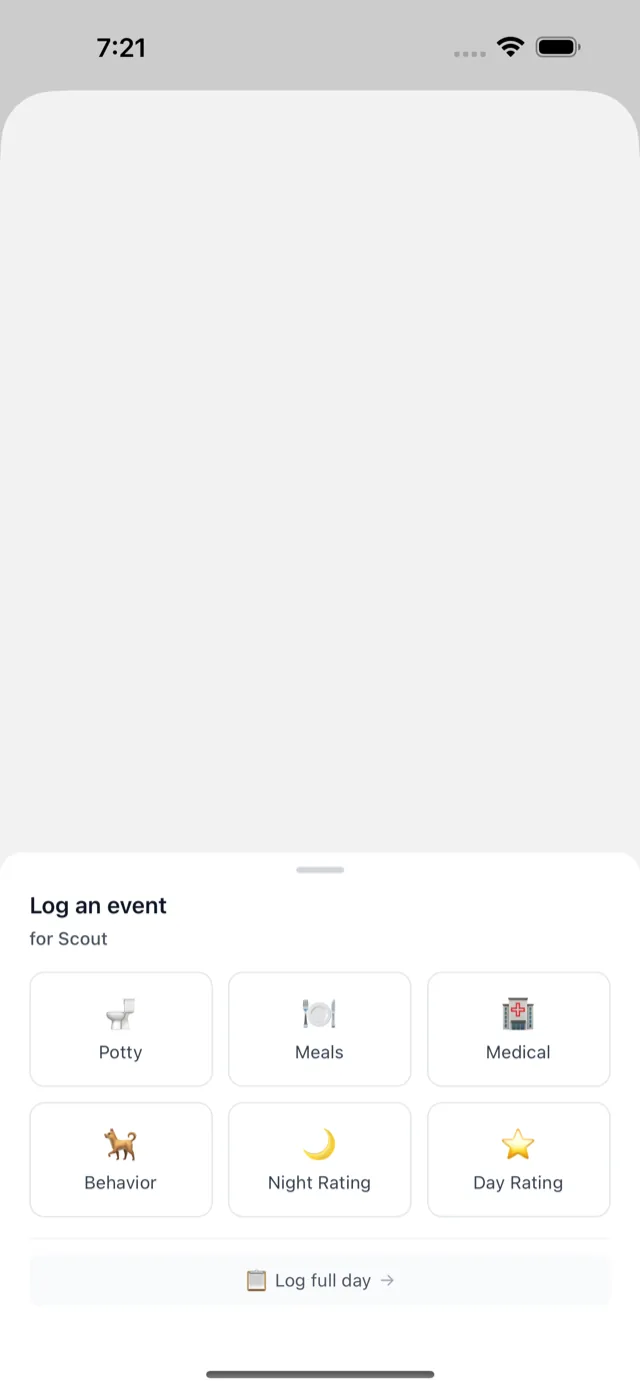
Screen shown is from the iPhone app, with our sample dog. A cat’s log sheet has the same tiles, on Android and in the web app too, and since October 27, 2026 an eighth, Weight, which this screen predates.
Everyone in your household logs into the same record from their own phone or a browser, and every entry shows who logged it; a sitter can have a temporary pass. For the appointment, the Vet report PDF from History lists her entries with their times and your notes (free for the last 60 days, any range on Premium), and a share link Premium gives your vet a read-only page of the last 90 days. The help pages cover logging and sharing with your vet, shared households shows how everyone’s entries land in one record, and the cat page has more on what to log for a cat. More posts are on the blog.


Free to use every day, the whole checklist included. Premium adds the full history, photos on entries, vet share links, every pet and the AI assistant — $3.99 a month or $24.99 a year, with a 14-day free trial for new subscribers in the iPhone and Android apps.