 WagWatch
Tracking a cat with kidney disease at home: water, appetite, litter box, weight
A cat with kidney disease sees the vet every few months. Everything that happens in between happens at home: the water bowl, the food bowl, the litter box and the scale. Written down, those four turn “she seems thirstier” into numbers your vet can compare from one visit to the next. Here is what to write, how to measure it without fuss, a weekly log you can print, and how to keep the same record in WagWatch with everyone who looks after your cat.
Kidney disease is common in older cats: Cornell’s Feline Health Center puts it at up to 40% of cats over 10 and 80% over 15. And the newest guidelines for vets, International Cat Care’s 2026 consensus guidelines, encourage exactly this kind of help from home: weighing the cat and keeping a diary, which they say keeps caregivers informed and talking with the clinic.
First: when to call now
If your cat strains in the litter box and passes little or no urine, call your vet or an emergency clinic now. Straining with little or no urine is how Cornell describes a cat with a blocked urethra, which it calls “a true medical emergency” that needs immediate veterinary attention. Male cats are more at risk.
If your cat stops eating, call your vet the same day. Cornell says not eating can have a severe impact on a mature cat’s health if it goes on for as little as 24 hours.
And call about anything your vet asked you to watch for. The log below is for the weeks between visits, not a reason to wait for the next one.
Why these four
Kidney disease moves slowly. The Merck Veterinary Manual’s edition for cat owners says it often goes on for months or years before a cat shows any sign, and that the earliest signs are usually drinking and urinating more — signs other diseases share. As it progresses, others can join them: loss of appetite, weight loss, dehydration, sluggishness, vomiting. Cornell adds that affected cats can look unkempt.
None of those is a number you can read off a cat. They are changes in things you already see every day, which makes them easy to write down and easy to miss: the 2026 guidelines point out that slow weight and muscle loss can go unnoticed at home, or be put down to age.
At each visit your vet weighs your cat, checks hydration and blood pressure, and tests blood and urine. Merck’s owner manual puts those visits at every 6 to 12 months, or more often as the disease advances or when there are problems. What the clinic cannot see is the weeks in between, and that is what your log is for.
Water: measure a day, don’t guess a week
A bowl that empties faster is the change people notice first, and a bowl is a poor witness: water evaporates, other pets drink from it, and some cats would rather drink from a faucet. So instead of eyeballing it every day, measure one day, the same day each week.
- Fill every bowl or fountain your cat drinks from with a measured amount, from a kitchen measuring jug, at the same time of day. If you top up during the day, measure the top-up too.
- Twenty-four hours later, measure what is left in each, and subtract. That number is the day’s water.
- If your home is warm or dry, set out a second bowl with the same amount where no animal can reach it, and take off whatever it lost.
- Write down the food next to the number. Cornell’s page on hydration notes that wet food can be up to 80% water, so a cat on wet food may drink little from a bowl and a cat on dry food drinks more. A change of food changes the bowl number on its own, and your vet will want to know which week it happened.
Never cut back the water to make the measuring easier. Merck’s owner manual says continuous access to water matters at every stage of the disease, and Cornell counts kidney disease among the most common causes of dehydration in cats.
If several animals share the bowls, you are measuring the household, not the cat. That is still worth writing down, as long as the log says so.
Appetite: what went in, not what you hoped
Kidney disease can bring nausea, vomiting and a poor appetite, and the 2026 guidelines call a poor appetite a significant quality-of-life concern for caregivers. What helps your vet is the pattern: which meals, how much of each, and which were refused.
- Every meal, with how much was eaten: all of it, some, or none. “Some” every evening for a fortnight is a pattern; one “some” is a meal.
- The day any food changes, whether your vet changed it or the shop was out of the usual one.
- Vomiting, with the time, and whether it came before or after a meal.
The litter box: clumps are your urine meter
Cornell describes cats with kidney disease passing larger volumes of urine and drinking more to keep up. At home, in a clumping litter, more urine shows up as more clumps, bigger clumps, or both, so the scoop is where you can see it.
- Count the urine clumps at each scoop, with a word for size: small, usual or large. Scoop at the same times each day so one day’s count compares with the next.
- Note the stool, and anything that happens outside the box, with where.
- Straining with little or nothing to show for it is not a log entry. It is the call in the box at the top of this page.
If cats share a box, you can count the box, not the cat, unless you saw who used it. Say so in the log.
Weight: the slow one
Weight loss is among the signs reported most often, and it is slow: the 2026 guidelines cite a study of more than 500 cats that had lost a median 8.9% of their body weight in the year before their kidney disease was found, with the loss already under way three years earlier. The guidelines’ line on it is that unintended weight loss should not be ignored.
- Once a week, same scale, same time of day, before breakfast if you can, and write the number down with the date.
- A kitchen or baby scale reads a cat more finely than a bathroom scale. On a bathroom scale, weigh yourself holding your cat and take off your own weight.
- Compare your numbers with each other, not with the clinic’s: home scales and the vet’s scale rarely agree to the gram, and the trend is what yours can show.
The printable weekly log
One page per week: the header once, then a row per day, with the week’s weight at the top. Print a few and keep one by the food bowls with a pen.
Kidney care log, one week
Straining in the box with little or no urine: call your vet or an emergency clinic now. Stopped eating: call your vet today.
| Day | Water in 24 h (on the measuring day) | Meals: all, some or none | Urine clumps: how many, how big | Stool, vomiting, anything outside the box | Doses given | Notes |
|---|---|---|---|---|---|---|
| Mon | ||||||
| Tue | ||||||
| Wed | ||||||
| Thu | ||||||
| Fri | ||||||
| Sat | ||||||
| Sun |
Keeping the log in WagWatch
WagWatch keeps the same log as entries in your cat’s record, next to the doses and everything else, shared by everyone in your household. Logging is free on every plan.
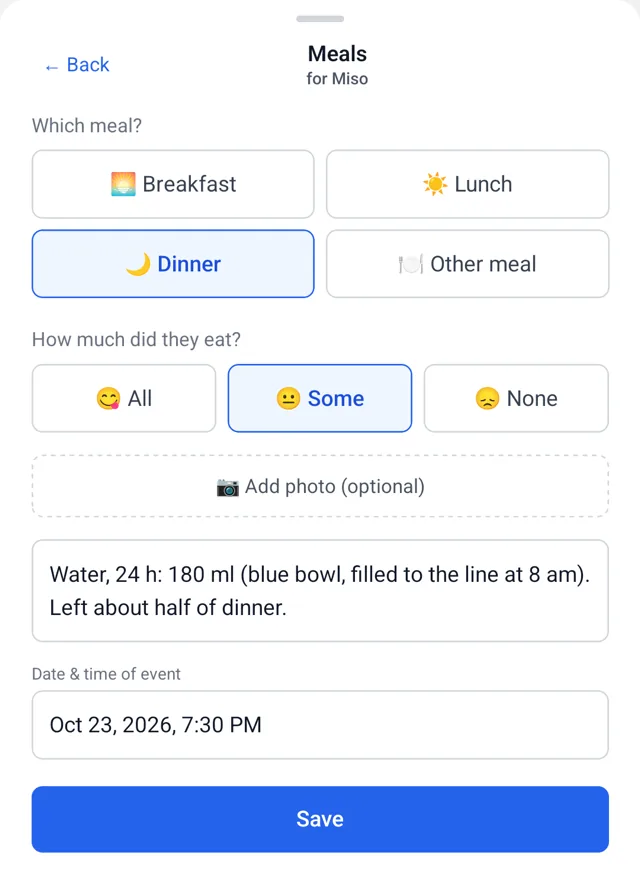
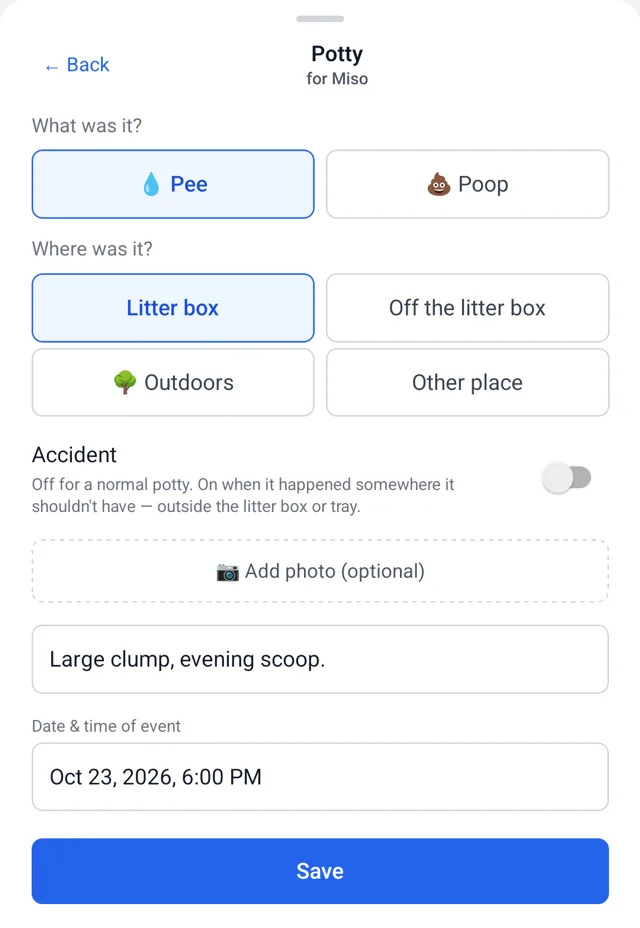
Screens shown are from the Android app, with one of our test cats. The iPhone app and the web app have the same forms.
- Meals. Log each one with All, Some or None; a refused meal is None. Put a change of food in that meal’s note, so it has a date.
- Water. WagWatch has no water counter, so write the 24-hour number in the note of that day’s evening meal, as in the picture. History’s Search notes and details then finds every one. When you notice a change you want dated on its own, log a Medical entry: Excessive thirst is on a cat’s list.
- Litter box. A cat’s Potty entry starts on Litter box, with Off the litter box and Outdoors beside it. Log a Pee for each clump when you scoop, with large in the note when it is, and the Potty per Week chart on Trends counts clumps week by week, with a dashed trend line. A Poop has a Diarrhea switch and asks how loose: soft, unformed or runny.
- Vomiting and appetite. Medical entries: a cat’s list has Vomiting, Hairball, Diarrhea and Loss of appetite, with an optional severity. Trends draws Medical Events per Week, one line per kind.
- Weight. Log each weekly weigh-in as a Weight entry, in pounds or kilograms. Trends draws the line, a day without a weigh-in showing the last weight logged, and your cat’s profile shows the newest. The Vet report PDF and the share page list the weigh-ins in their range.
- Doses. Record each medication once, with its dose and how often. Reminders arrive as push notifications on the iPhone and Android apps; every dose you log sits in the history beside everything else, and with a reminder set, the Reminders card on Home says who gave today’s dose and at what time. How medications work.
Everyone in your household logs into the same record from their own phone or a browser, and every entry shows who logged it, so whoever scooped the box is the one who writes down the clumps. If a sitter has your cat while you are away, the household owner can give them a temporary pass: they see today’s entries and the medication schedule, and log into the same record. How shared households work.
At each visit
- The printed weekly logs, or the weights you wrote down, in order.
- The Vet report PDF, from History: your cat’s profile and medications, then every entry in order with its time and your notes. Free for the last 60 days; any range on Premium.
- A share link Premium: a read-only page your vet opens without an account, with the last 90 days of entries and the medication and vaccine lists. It ends after 30 days, or when you revoke it. What your vet sees.
For everything else worth bringing, there is a one-page checklist of what to write down before a vet appointment. The help pages cover logging and sharing with your vet step by step.
Questions
How much water is too much for my cat?
That is your vet’s to say, for your cat, alongside the blood and urine tests and the food your cat eats. What the clinic does not have is your cat’s own number, week after week, measured the same way. Bring that.
My cat eats wet food and hardly drinks from the bowl. Is the number still worth writing down?
Yes, as a comparison with itself. Wet food can be up to 80% water, Cornell notes, so a cat on wet food may drink little from a bowl. Keep the food in the log next to the water, and a change in either stays readable.
Can WagWatch tell me whether it is getting worse?
No. WagWatch keeps the record and draws it back as counts and lines, and it does not say what they mean. How the disease is doing is your vet’s reading of blood and urine tests, blood pressure and weight, with your log beside them.
Should I cut back water to stop accidents outside the box?
No. Merck’s owner manual says continuous access to water matters at every stage. Log the accidents, with where they happened, and ask your vet about them.
Sources
Every general statement about kidney disease, dehydration, blockages and appetite on this page comes from one of these veterinary sources. WagWatch is not connected to any of them.
- Chronic Kidney Disease, Cornell Feline Health Center, Cornell University College of Veterinary Medicine
- Hydration, Cornell Feline Health Center
- Feline Lower Urinary Tract Disease, Cornell Feline Health Center
- Anorexia, Cornell Feline Health Center
- Noninfectious Diseases of the Urinary System of Cats, Merck Veterinary Manual, cat owners’ edition, by Scott A. Brown, VMD, PhD, DACVIM
- 2026 iCatCare consensus guidelines on chronic kidney disease in cats, Taylor S, Finch N, Caney S and others, Journal of Feline Medicine and Surgery, 2026
Not a substitute for your vet
WagWatch is a tracking and logging tool, not a veterinary service. Its job is to help you bring a clear, accurate history to the people who care for your pet professionally.
Start this week
Pick a measuring day, print the log, and put the scale where you will see it. Or add your cat in WagWatch and log tonight’s dinner, with the day’s water in its note. Either way, the first week is the one every later week gets compared with.


Free to use every day, the whole log included. Premium adds the full history, photos on entries, vet share links, every pet and the AI assistant — $3.99 a month or $24.99 a year, with a 14-day free trial for new subscribers in the iPhone and Android apps. More posts are on the blog, and the cat page has more on what to log for a cat.