 WagWatch
Dog in pain signs: a body-language guide
Key takeaways
- Dogs often hide pain, so watch for changes in posture, movement and daily habits, not only for yelping.
- Slowing down on stairs, skipping meals and restless nights can be signs of pain, and are easy to put down to age.
- Abdominal pain can show in posture, such as the “praying” position or a tucked-up belly, rather than in a limp or a guarded leg.
- A hard, swollen belly with retching that brings nothing up is an emergency: go to an emergency clinic now.
- Writing down specific dates and behaviors gives your vet a pattern to act on instead of a vague mood.
Dog in pain signs often show in the body rather than the voice: a tucked-up belly, stiffness after a rest, a head carried low, an arched back after a restless night. This guide organizes those signals by body region and by situation, so you can notice pain earlier and describe exactly what you saw to your vet.
A hard, swollen belly with retching that brings nothing up, pale gums, collapse, or crying out in pain: go to an emergency clinic now, and call ahead on the way. Each is on the emergency lists of the University of Wisconsin’s or Texas A&M’s veterinary teaching hospitals; the full list is below. A log is for the days between visits, never a reason to wait.
What are the earliest body language signs a dog is in pain?
Look for changes in posture and movement, not only for yelping: weight shifted off one leg, a sit that lowers in slow motion, false starts before lying down. Cornell’s Riney Canine Health Center lists an arched back, a head carried low, stiffness, and difficulty sitting, climbing stairs or getting up among the changes that could indicate pain.
Posture changes, not just vocal signals
Watch the transitions, not the stillness. The walk down stairs that now happens one step at a time, the tail held lower than usual, the reluctance to shake off after a nap. These “small changes” are exactly what a vet wants to hear about, and AAHA’s handout on pain signs in dogs calls stiffness after rest, with no hard exercise to explain it, cause for concern.
Facial signals: ears, eyes, muzzle, lip licking
Cornell lists flattened ears, grimaces and glazed eyes among the signs of pain, and the 2022 AAHA pain management guidelines name licking the lips, holding the breath and looking away as quiet reactions to being handled. Write down what you saw, and when.
Why “quiet” does not mean “comfortable”
A calm dog can still be a hurting dog: the AAHA guidelines say calm behavior and a poor appetite can be subtle signs of pain, and the Merck Veterinary Manual notes a dog might still wag its tail and greet people while in pain. If multiple people share care, one person’s “she seemed herself” may hide what another saw at dinner. Logging who noticed what, when, keeps the pattern from dissolving into conflicting memories, and our terms cover how those shared entries are handled.
Why do dogs hide pain, and which subtle signals do owners most often miss?
The survival instinct behind hiding pain
A Texas A&M veterinarian puts it plainly: dogs and cats often have a natural instinct to hide signs of pain, because it would keep them alive in the wild. Your dog is not being stoic or brave; she is doing what dogs do, which is exactly why the first signs are so easy to miss.
Five changes that are easy to put down to age
Slowing down on stairs, a skipped meal, a restless night, less interest in play, and grooming less. Each one gets blamed on age; each is on a veterinary list of possible pain signs, and the AAHA handout says less play is sometimes confused with aging. Together, they can be the pattern that says pain.
Why gradual changes are invisible day to day
Nobody watches a senior dog change in a single afternoon: Cornell notes that behavior changes from pain often develop gradually, and the AAHA guidelines say owners may explain the signs away for months. Each caregiver sees a slice: you notice she hesitated on the stairs, your partner notices she skipped breakfast, the walker notices a stiff start to the walk. No single person sees the whole picture, so the pattern stays invisible until a vet visit forces the question.
This is the gap WagWatch was built for: everyone in the household logs the day into one shared record, so small changes line up into a pattern you can describe to your vet. What happens to those logs is in why WagWatch does not sell your data.
How do signs of dog abdominal pain differ from general pain signs?
Much of the pain owners notice shows in how a dog moves: a limp, a guarded limb, reluctance to jump. Abdominal pain may not touch the legs at all. It shows in posture, appetite and restlessness, which is why owners can misread it as fussiness; the Merck manual notes that many dogs may simply be less interactive or eat less.
The praying position and other posture clues
One signal to know is the “praying” position: hindquarters raised, chest and forelegs close to the floor, which Merck’s owner edition ties to abdominal pain. AAHA adds a “tucked up” look, and the American College of Veterinary Surgeons lists standing and stretching among early signs of bloat. A stretch on waking can look similar, so note how long she holds it. A skipped meal plus a restless night together is a pattern worth logging, not two separate oddities; seven small changes worth logging in a senior pet covers more.
Guarding, bloating, and a hard belly
Watch for a flinch when the belly is touched, a swollen or drum-tight abdomen, and retching with nothing coming up. All three are on Cornell’s list of bloat signs, so a rounded, hard belly is not a log entry. It is the emergency below.
When abdominal signs become an emergency
A hard, swollen belly with unproductive retching can mean bloat, gastric dilatation-volvulus (GDV), which Cornell’s Riney Canine Health Center calls life-threatening and in need of immediate care. It is far more common in large, deep-chested dogs, though it can occur in any size or breed, and Merck says to seek veterinary care immediately. If you see that combination, go now; log it afterwards.
What are the signs a dog is in pain after surgery, and which are urgent?
What your clinic tells you to expect
Start with the discharge instructions: the American College of Veterinary Surgeons says your surgeon supplies them, covering pain control, activity limits and incision care, and AAHA says pain at home should be judged with the veterinary team’s guidance. Your clinic’s sheet, not a general article, says what to expect. Log against it: every dose, every meal, every look at the incision.
Urgent signs: incision, digestion, and pain level
| Sign | What to write down | Call the clinic about (ACVS) |
|---|---|---|
| Incision | How it looks at each check, with the time | Increasing redness, swelling, heat, discharge, odor, or the incision opening |
| Eating | Each meal, and how much went | Poor appetite lasting longer than your clinic said it would, vomiting, or worry about drinking |
| Digestion | Each pee and poop, and any straining | Difficulty or inability to urinate, significant straining, diarrhea, blood in urine or stool |
| Pain level | Pacing, panting, whining, how she settles at night | Persistent or worsening pain, crying out, reluctance to move, or growing weakness |
Crying out when touched anywhere, or any sudden change in comfort, is a reason to call the clinic. If you are unsure whether a change matters, ACVS says it is always appropriate to call.
Why a written log matters most in the recovery window
Multi-caregiver households lose the thread here: the walker sees the skipped meal, the partner sees the restless night, and nobody assembles the pattern. A shared log closes that gap, which is the problem WagWatch was built around. ACVS says changes should be reported, with photos or videos, rather than saved for the recheck. Bring the log to the recheck too; it turns “she seemed off” into times and dates.
How does pain body language differ between puppies, adults, and senior dogs?
Cornell notes that dogs show pain differently by breed, individual, age and how long it has gone on, and AAHA that chronic pain can develop even in young dogs. At any age, the comparison that counts is with your own dog. Senior dogs are different again: pain can arrive as slow, cumulative change, and owners file it under “just getting old.”
Senior dogs: when “slowing down” may be pain
A senior dog who hesitates at stairs, takes longer to settle at night, or stops jumping onto the couch may be showing pain, not age: Texas A&M names osteoarthritis as the most common cause of pain in pets, and stairs and jumping among the signs. Watch the small changes: a restless night, a skipped meal, reluctance after a long lie-down. In multi-caregiver households, one person sees the morning stiff walk and another sees the evening pacing, so neither has the whole picture. A shared log like WagWatch exists because no single caregiver sees the pattern; a sitter logging one skipped meal can complete it (how shared care logging works).
Chronic conditions that change the signal set
Long-term conditions bring signs of their own. Kidney disease usually shows first as excessive thirst and urination, the Merck manual says; osteoarthritis shows in movement. Night-time restlessness has more than one possible cause, pain among them, so write down what you see and let your vet sort it out. After surgery, your clinic’s instructions come first.
Why the baseline matters more than any single day
One day is one entry. Three weeks of “she takes longer to stand up after naps” is a pattern, and exactly the sentence your vet needs. Write down how she has been compared with her usual, not compared with her worst day.
What should you write down about your dog’s pain signs before a vet appointment?
Write down what you saw, when it happened, how often, and what changed. Dates and behaviors, not adjectives: “skipped breakfast Tuesday and Wednesday,” not “she seems off.” Vets can act on a pattern; they can only guess at a mood.
The observation checklist: what, when, how often, what changed
For each day, note: appetite (eaten, picked, skipped), sleep (restless night or settled), movement (stairs, jumps, stiff after rest), posture (hunched, stretching, guarding the belly), and anything you did differently, like a missed dose. One line per day is enough. Because dogs tend to hide pain, gradual changes rarely announce themselves, and the log is how you catch what the dog keeps quiet.
Turning body language into words a vet can use
“She seems off” tells a vet almost nothing, and Cornell notes that anxiety or fear can mask pain behaviors at the clinic itself. A written log works around that. Replace adjectives with observations: “stopped taking stairs without hesitating on the 3rd; sits with left hind leg extended; skipped two meals this week; pace changed the day after her arthritis dose moved to evenings.” Each entry has a date, a behavior, and a change from before, so the vet sees a timeline instead of a summary. If a course of medication was finished, write that down too, with dates. Cornell also suggests photos and videos. Bring the log to the appointment and hand it over; it takes the vet less time to read than for you to remember.
Sharing the log when a sitter or partner saw the signs first
No single person sees the whole picture, so the log needs to be shared, not kept in your head. A shared notebook or a simple shared app where a walker or partner can log a skipped meal keeps the pattern in one place instead of scattered across texts. WagWatch is built for exactly this: everyone who cares for the pet logs the day, so what the sitter noticed on Thursday is next to what you noticed on Friday. Be honest about where it falls short: it won’t replace your vet’s records, and a sitter who forgets to log leaves the same gap a notebook would.
When do signs of dog pain mean an emergency vet visit?
Time-critical signs, listed plainly
Go to an emergency clinic now if you see any of these, all on the Wisconsin or Texas A&M emergency lists or Cornell’s signs of bloat:
- A hard, tight, or distended belly, especially with retching or unproductive vomiting (trying to throw up, nothing comes out)
- Pale, white, blue or purple gums
- Collapse, or inability to stand or walk
- Crying out in pain, or severe pain when touched or moved
- Restless pacing and a swollen abdomen together, which can mean bloat
A distended belly with retching is among the most common signs of gastric dilatation-volvulus, which Cornell calls life-threatening. Do not wait to see if the skipped meal resolves on its own. Call the emergency clinic on the way so they are ready.
What to bring with you
Bring her medications and the last dose time, plus anything you logged about the before and after: when she last ate, when the restless night started, what the pattern looked like over the past day. If several people share care, ask the walker or sitter for their notes by phone on the way; do not wait for them. A short written history beats a vague “she’s been off” at triage.
Questions
What are the 5 signs your dog is in pain?
There is no official five, but five changes easy to put down to age are slowing down on stairs, a skipped meal, a restless night, less interest in play, and grooming less. Together they can form a pain pattern. Also watch for a tucked-up belly, an arched back or flattened ears.
How do I know if my senior dog is in pain or just old?
Compare her with her own usual, not with a younger dog, and ask your vet. Hesitating at stairs, taking longer to settle at night, or no longer jumping onto the couch can be signs of pain. Three weeks of taking longer to stand up after naps is a pattern, and that exact sentence is what your vet needs.
What are the signs of dog in pain after surgery that I should worry about?
Your clinic’s discharge instructions come first. ACVS lists reasons to call: increasing redness, swelling, heat, discharge, odor or opening at the incision; poor appetite lasting longer than your clinic said, vomiting, or difficulty urinating; and persistent or worsening pain, crying out, or reluctance to move. If you are unsure, call.
How can I tell if my dog has abdominal pain?
It often shows in posture rather than the legs: the “praying” position, a tucked-up belly, standing and stretching, restlessness. A flinch when the belly is touched plus a skipped meal is a pattern to show your vet. A hard, swollen belly with retching that brings nothing up is an emergency: go now.
How do I describe my dog’s pain to the vet?
Bring dates and behaviors, not adjectives. Write down “skipped breakfast Tuesday,” not “she seems off.” Note appetite, sleep, movement, posture, and anything you changed, like a missed dose. Include when a medication course finished. Vets can act on a pattern with dates, but they can only guess at a mood.
Sources
Every general statement about pain, bloat, recovery from surgery and emergencies on this page comes from one of these veterinary sources. WagWatch is not connected to any of them.
- Recognizing pain in dogs, Riney Canine Health Center, Cornell University College of Veterinary Medicine, by Aly Cohen, DVM, 2025
- Gastric dilatation volvulus (GDV) or “bloat”, Riney Canine Health Center, Cornell, 2025
- 2022 AAHA Pain Management Guidelines for Dogs and Cats, Gruen ME, Lascelles BDX and others, Journal of the American Animal Hospital Association, 2022
- 15 Signs of Pain in Dogs, American Animal Hospital Association handout, from Michael Petty, DVM
- Recognizing and Assessing Pain in Animals, Merck Veterinary Manual, by Nick Roman, DVM, MPH, 2025
- Disorders of the Stomach and Intestines in Dogs, Merck Veterinary Manual, dog owners’ edition
- Pancreatitis in Dogs and Cats, Merck Veterinary Manual, by Jörg M. Steiner, 2025
- Noninfectious Diseases of the Urinary System in Dogs, Merck Veterinary Manual, dog owners’ edition, by Scott A. Brown
- Postoperative Care After Surgery: What Animal Owners Should Expect, American College of Veterinary Surgeons
- Gastric Dilatation-Volvulus, American College of Veterinary Surgeons
- Detecting the Subtle Signs of Pain (2019) and Chronic Pain In Pets Part 1 (2022), Pet Talk, Texas A&M College of Veterinary Medicine & Biomedical Sciences
- Emergency Medicine, Veterinary Medical Teaching Hospital, Texas A&M
- When to Seek Emergency Care for your Pet, University of Wisconsin School of Veterinary Medicine, 2023
Not a substitute for your vet
WagWatch is a tracking and logging tool, not a veterinary service. Its job is to help you bring a clear, accurate history to the people who care for your pet professionally.
Log it in WagWatch
WagWatch keeps these observations as dated entries in your dog’s record, shared by everyone in your household. Logging is free on every plan.
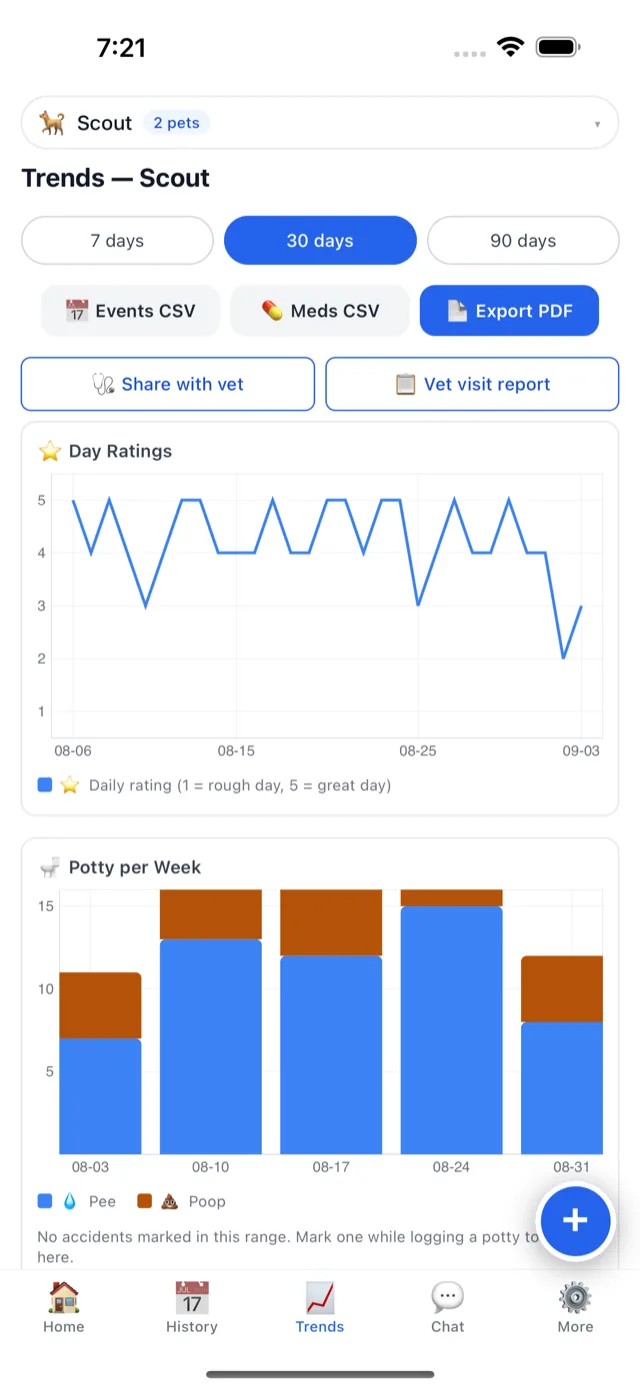
Screen shown is from the iPhone app, with our sample pet. The Android app and the web app draw the same charts.
- Behavior. A dog’s list has Pacing, Whining, Hiding, Excessive panting, Excessive licking, Extreme tiredness and Loss of interest, and every entry takes a note in your own words: “hesitated at the stairs.”
- Medical. Limping, Vomiting and Loss of appetite are on the list, with an optional severity, and Other (custom) takes your own words.
- Days and nights. A 1–5 rating for the day, and one for the night with a note. Trends draws the day rating day by day and behavior entries as weekly bars; night ratings are in History.
- Photos Premium: the posture or the incision, on the entry itself.
- At the visit. History’s Vet report PDF prints every entry in order with its time and your notes: free for the last 60 days, any range on Premium. A share link Premium shows your vet, without an account, the last 90 days’ counts and your medical entries in full. What your vet sees.
If a sitter has your dog while you are away, the household owner can give them a temporary pass: they see today’s entries and the current medication schedule, and log into the same record. The help pages cover logging and sharing with your vet step by step, and the dog page has more on what to log for a dog. More posts are on the blog.


Free to use every day, the whole log included. Premium adds the full history, photos on entries, vet share links, every pet and the AI assistant — $3.99 a month or $24.99 a year, with a 14-day free trial for new subscribers in the iPhone and Android apps.