 WagWatch
How to keep a seizure diary for your pet (what your vet will ask you)
Watching your pet have a seizure is frightening, and it is usually over before anyone thinks to look at a clock. Afterwards, your vet asks exactly the things that are hardest to remember: when it started, how long it lasted, what it looked like, how your pet was afterwards. A seizure diary is those answers, written down while they are fresh. Here is what to write, a log you can print, and how to keep the same diary in WagWatch with everyone who looks after your pet.
Dogs and cats both have seizures: NC State’s veterinary hospital estimates that epilepsy affects up to 1% of dogs and 2% of cats. Everything below is written for both.
First: when it is an emergency
If a seizure lasts more than five minutes, or your pet has more than one in a day, call your vet or an emergency clinic now.
That is the line NC State’s veterinary hospital draws. Cornell’s Riney Canine Health Center says a dog that has been seizing for more than five minutes should go to the clinic immediately, and Cornell’s Feline Health Center says a cat whose seizures come less than 10 or 15 minutes apart needs a vet without delay.
If it is the first seizure you have seen, call your vet once your pet has recovered and ask for an exam as soon as possible; that is Cornell’s advice after a dog’s first seizure. The diary can wait. The phone call cannot.
While it is happening
NC State’s advice for the minute itself is short: stay calm and note the time it begins. Keep your pet on the floor so it cannot fall, and away from stairs and water, with children and other pets kept back. Keep your hands away from its mouth: animals are not at risk of swallowing their tongues, and you may be bitten.
If someone else is there, one of you watches the clock and the other films. Cornell calls a video “immensely helpful”, because your vet has to decide whether the event was a seizure at all, and Tufts’ Cummings School of Veterinary Medicine says to write down what you saw as soon as possible afterwards or, better, take a video.
Cornell adds one caution for afterwards: in the minutes to hours after a seizure a dog may stay disoriented or confused, sometimes to the point of aggression. Give your pet room while that passes.
What to write down, and why your vet asks
NC State’s list for a seizure diary is four things: the date, the time, how long it lasted, and a description. Tufts adds how often seizures happen and which parts of the body were affected. Those are the questions you are likely to hear at the appointment, and the log further down has a column for each, plus what came before and after.
- The date, and the time it started. Look at a clock as soon as you realize what is happening, and write that time, not the time you found a pen. If you found your pet already seizing, or afterwards, say so: “found at 3:10, already going”.
- How long it lasted, by the clock. Use a phone timer or the length of the video rather than a guess. Cornell explains why timing matters: a seizure that does not stop on its own, usually taken as one lasting more than five minutes, is life-threatening.
- What it looked like, in plain words. Which parts of the body moved, and how: the whole body or one leg, stiff or jerking, the face twitching. Whether your pet seemed aware of you. Drooling, and whether they wet or soiled themselves. NC State describes jerking of the head, face or legs, often without awareness of the surroundings, and drooling or passing urine or stool; Cornell also describes stiff, extended legs, and seizures as small as “repeated twitching of an eyelid, lip or ear”. Write down whichever you saw, small ones included.
- Before. What your pet was doing (asleep, playing, eating) and where, and anything different about the day: visitors, a change of routine, a new food, a dose that was missed or late.
- After. What you saw, and how long until your pet was their usual self again. NC State describes a period afterwards, lasting minutes to hours, when animals can be unsteady or temporarily unable to see, and can seem confused, disoriented or restless. Write down what you saw and when it ended, not what you think it means.
- Doses. Every dose of every medication, when it was given, and any that were missed or late. There is more on this below.
- Where the video is. “On Sam’s phone, 9:42 pm” is enough. A video nobody can find at the appointment does not help.
What about triggers?
Tufts calls a seizure diary “a proactive way to help identify potential triggers”, and says stress, anxiety, certain foods and certain medications are the ones owners often note. It also says triggers are rare: most dogs have seizures without any trigger at all, typically while asleep. So write down what was going on either way, and leave the pattern-finding to the diary and your vet. A “Before” that says “asleep, nothing different” is information too.
Why a diary, and not a memory
One seizure is an event; the diary is what shows a direction. Cornell describes the log as how you and your vet see whether seizures are getting longer, more frequent or more severe over time. NC State says the diary helps your vet as decisions are made, and recommends regular check-ups at which it is reviewed. None of that can be read from the last seizure alone, and all of it can be read from a column of dates.
The printable seizure log
One page: the header once, then a row per seizure. Print a few, and keep one with a pen wherever the seizures usually happen.
Seizure log
Longer than 5 minutes, or more than one in a day: call your vet or an emergency clinic now.
| Date, and time it started | How long, by the clock | What it looked like | Before | After, and how long until their usual self | Doses: any missed or late? | Video? On whose phone |
|---|---|---|---|---|---|---|
The dose record belongs in the diary
If your pet takes medication for seizures, the dose record matters as much as the seizure record. NC State’s neurology service stresses that seizure medication be given consistently, at the dose your vet set, because sudden changes can themselves bring on seizures. Tufts calls it “imperative” to have a routine for giving it and to know who is responsible. So your vet is likely to want to know whether a seizure came after a missed or late dose, and the diary needs both halves: the doses that were given, and the ones that were not. Ask your vet before changing anything about a dose.
For a dose chart on paper, the pet medication schedule template prints a week to a page.
Where paper falls down
A log on the fridge has three weaknesses with seizures. The person who saw it is often not the person who keeps the log, and by the time it is written down, the times have become “about”. It happens at night, at a relative’s house or while a sitter has your pet, and the sheet is somewhere else. And the dose chart and the seizure log are two pieces of paper, so “was a dose missed the day before?” means laying them side by side.
Keeping the diary in WagWatch
WagWatch keeps the same diary as entries in your pet’s record, next to the meals, the doses and everything else, and shared by everyone in your household. Logging it is free on every plan.
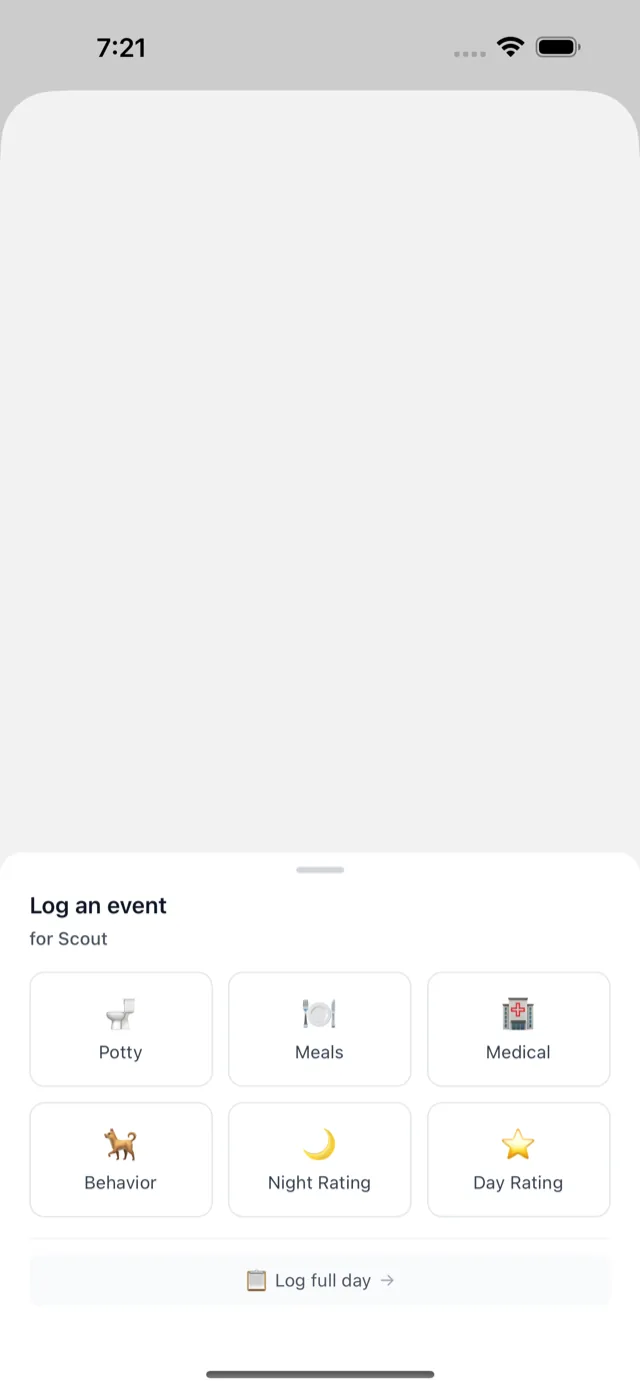
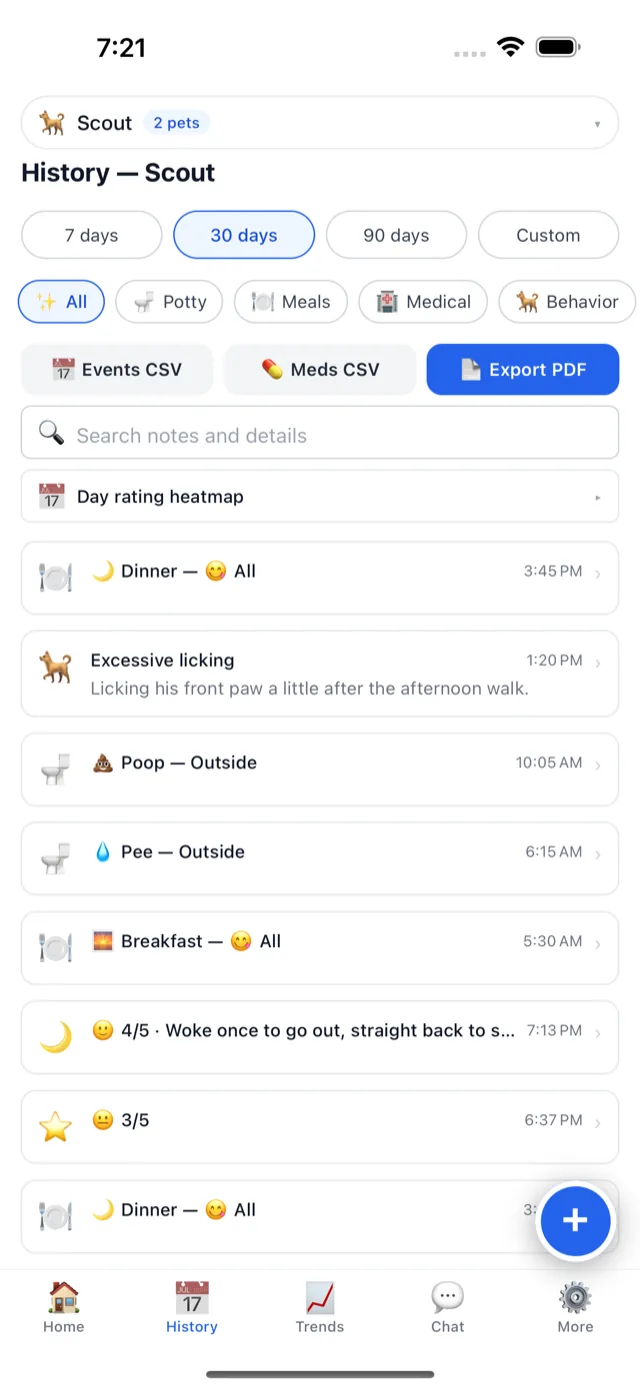
Screens shown are from the iPhone app, with our sample pet. The Android app and the web app have the same Medical entry, and the same History filters, search and Vet report PDF.
- Open the log sheet (the + button) and choose Medical. Under What happened?, choose Seizure: it is on the list for a dog or a cat, and for several other kinds of pet. If you are not sure it was one, or want your own words, choose Other (custom) and describe it.
- Set the time to when it started. Every entry has a date and time you can adjust, so you can log it calmly half an hour later and still record the minute it began.
- Answer How severe was it? if you like. Mild, moderate or severe is your own word for it, not a measurement, and it can be left blank.
- Write the rest in Notes: how long it lasted, what it looked like, what came before, what came after and how long until your pet was their usual self, and where the video is. There is no timer or length field in WagWatch; the notes are where the length goes.
- If something afterwards deserves its own time, log it as a Behavior entry. Confusion and Extreme tiredness are on the list for dogs and cats.
Entries hold photos on Premium, but not video. Keep the video on your phone, and say in the notes whose phone it is on.
Doses, and everyone who gives them
Record each medication once, with its name, dose, how often and when it started. Reminders arrive as push notifications on the iPhone and Android apps at each time you set; every dose you log sits in the history beside the seizures, and a dose nobody logged shows as a gap. If you keep a reminder for a medication, the Reminders card on Home also says who gave today’s dose and at what time. How medications work.
Everyone in your household logs into the same record from their own phone or a browser, and every entry shows who logged it, so the person who saw the seizure is the one who writes it down. If a sitter has your pet while you are away, the household owner can give them a temporary pass: they see today’s entries and the current medication schedule, and can log a seizure into the same record. How shared households work.
Finding the pattern later
- History filters by kind of entry and searches your notes and details, so filtering to Medical, or searching for “seizure”, lists every one in the range you are looking at, with its time.
- Trends charts medical entries per week, one line per kind, so seizures get a line of their own.
- How far back: the free plan shows the last 60 days, and Premium the whole history. The free plan keeps older entries and only stops showing them, and the free export (More, then Export Data) covers your whole history.
At the appointment
- The Vet report PDF, from History: your pet’s profile and medications, then every entry in order with its time, what it was (and how severe, if you said) and your notes. Free for the last 60 days; any range on Premium.
- A share link Premium: a read-only page your vet opens without an account, with every medical entry from the last 90 days — its date, what it was, how severe if you said, and your notes — and the full medication list. It ends after 30 days, or when you revoke it. What your vet sees.
- The video, on whichever phone has it.
For everything else worth bringing, there is a one-page checklist of what to write down before a vet appointment. The help pages cover logging and sharing with your vet step by step.
Questions
What if I am not sure it was a seizure?
Write it down anyway, in your own words, with the time and how long it lasted. Deciding whether it was a seizure is your vet’s job: Cornell names heart and balance problems as the main things to tell apart from a seizure, and notes that a heart rhythm problem can be mistaken for one, which is why a description and a video matter so much. In WagWatch, choose Other (custom) and describe it, or choose Seizure and say in the notes that you are not sure.
I did not see it start. What do I write?
What you know: the time you found your pet, what was happening, how long it went on from then, and what you saw afterwards. “Found at 3:10, already going, stopped about 3:12” is a useful entry.
Does WagWatch tell me whether something is wrong?
No. WagWatch keeps the record and shows it back to you and your vet. Logging a seizure does not contact anyone, and the app cannot tell you what one means. If a seizure is happening now, or has gone on for more than five minutes, call your vet or an emergency clinic first and log it afterwards.
Sources
Every general statement about seizures on this page comes from one of these veterinary-school pages. WagWatch is not connected to any of them.
- Neurology: Companion Animal Epilepsy, NC State Veterinary Hospital
- Managing seizures, Riney Canine Health Center, Cornell University College of Veterinary Medicine
- Neurological Disorders, Cornell Feline Health Center, Cornell University College of Veterinary Medicine
- 10 Facts About Canine Epilepsy Revealed, Cummings School of Veterinary Medicine at Tufts University
Not a substitute for your vet
WagWatch is a tracking and logging tool, not a veterinary service. Its job is to help you bring a clear, accurate history to the people who care for your pet professionally.
Start today
Print the log and put it where the seizures usually happen, or add your pet in WagWatch and log the next one as a Medical entry, with the time it started and how long it lasted. Either way, look at the clock first.


Free to use every day, the seizure diary included. Premium adds the full history, photos on entries, vet share links, every pet and the AI assistant — $3.99 a month or $24.99 a year, with a 14-day free trial for new subscribers in the iPhone and Android apps. More posts are on the blog.